A developer's guide to how MinIO actually works under the hood: the S3-compatible API surface, the server/drive/erasure-set/pool layout, Reed-Solomon erasure coding, the write and read paths, healing, and how a deployment scales and replicates.
Student edition · understand, apply, verify
Understand how an object store reconstructs bytes from erasure-coded shards and safely publishes versions.
What you should be able to do: Calculate erasure overhead and recoverability, then distinguish coding math from commit/version and failure-domain guarantees.
Assumes basic programming and HTTP. This is an architecture-level tutorial, not a release-specific implementation contract. Defaults, file formats, APIs, and guarantees depend on the deployed release and configuration; use the linked product documentation before production changes. Snippets marked pseudocode are not runnable integrations.
MinIO distributes request coordination across storage servers. Those servers are not stateless: persistent object shards, metadata, runtime coordination, and recovery state still matter. Coding and valid-version commit rules provide recoverability only within the stated fault model.
Read these definitions first, or use the linked terms as you go. The examples and limitations are local to this guide; companion pages are optional.
Reed–Solomon erasure coding
Encode k data shards into n=k+m total shards with m parity shards. Any k compatible valid shards reconstruct under the code's assumptions. GF(256) is a finite field with 256 elements represented as bytes: addition is XOR, and multiplication uses a polynomial rule rather than ordinary integer arithmetic. Reed–Solomon constructs compatible linear equations over that field so enough distinct shards recover the data.
Example. 16-shard EC:4 uses k=12: nine shards cannot reconstruct. Ideal storage is 16/12≈1.333×, or 33.3% overhead relative to data.
Boundary. Parity fraction m/n=25% is not overhead m/k. A server can hold several shards; metadata/version/checksum/commit rules matter.
Quorum
A set of replicas whose responses are sufficient for an operation. In a fixed set of N replicas, read size R and write size W overlap whenever R+W>N. A majority is one particular quorum, not the definition of every quorum.
Example. With N=3, writes to {A,B} and reads from {B,C} share B. If the write completed durably and replicas preserve a comparable version, B carries that version forward.
Boundary. Overlap alone does not provide linearizability: concurrent or failed writes, sloppy replica sets, and version selection matter. Consensus adds protocol rules to preserve decisions.
Failure domains and redundant capacity
A failure domain is a set of components vulnerable to one shared event: process, host, rack, zone, or region. Redundancy must separate domains and leave enough surviving capacity to carry peak demand.
Example. Five replicas placed 2/2/1 across three regions leave at least three after any one region fails. A 3/1/1 layout can lose its quorum with the largest region.
Boundary. Independent-failure probability formulas are illustrative assumptions. Shared code/config, dependencies, routing, and control planes can fail all replicas together. N+1 machines does not imply tolerance of a whole zone.
Multi-tenancy and publication lifetime
A tenant scopes data/users/quotas/authorization. Immutable publication needs a catalog snapshot and safe file lifetime for readers.
Example. A query using old files must finish before compaction deletes them.
Boundary. Blob upload and catalog publication are separate operations. WAL-bearing ingesters are stateful; actual metadata/backend/visibility behavior is release-sensitive.
Content addressing and garbage collection
An object is named by a cryptographic hash of its canonical bytes. Immutable versions reference object hashes. Garbage collection deletes only objects that no retained version or active upload can still use.
Example. Two file revisions reference one unchanged chunk. Deleting one revision must not delete that chunk while the other still references it.
Boundary. Hash matches need an explicit collision model; cross-tenant existence checks can leak content. A grace period alone is insufficient for unbounded uploads: pin active sessions or bound their lifetime.
1. Design Goals and Core Ideas
Every internal decision in MinIO traces back to a small set of goals. Keeping them in mind makes the rest of the architecture predictable.
Goal
How MinIO achieves it
S3 compatibility
Speaks the Amazon S3 REST API natively. Existing S3 SDKs, tools, and applications work unchanged against the same endpoint.
High throughput
A lean Go binary streams objects straight to and from drives. Erasure encode/decode is SIMD-accelerated; there is no separate metadata service in the hot path.
Simplicity
One static binary, no external database, no config server. A deployment is just servers + drives + an endpoint.
Durability without 3x cost
Reed-Solomon erasure coding survives multiple simultaneous drive/server failures while storing far less redundant data than full replication.
Software-defined & portable
Runs on bare metal, VMs, or Kubernetes with commodity drives. No proprietary hardware, no kernel modules.
2. Architecture and Deployment Layout
MinIO distributes object operations across a storage deployment; a request-serving node coordinates operations, but that does not make storage nodes stateless. Persistent shards, metadata, configuration, and runtime ownership/recovery are state.
Define total erasure-set drives n, parity m, and data-equivalent shards k=n−m consistently. Sets span configured drives/servers; one server can own several drives in a set. Evaluate failures by the number of affected shards and independent domains, not 'one server always means one shard'. Pool and layout support are release-specific.
Within a pool, set placement can be determined from object identity under its configured mapping. Pool choice and cross-pool discovery are separate: free-space-aware placement of new objects cannot universally be recomputed from name alone. Expansion/decommissioning require supported coordinated procedures, capacity, and observed health.
3. Erasure Coding
Reed–Solomon turns k data units into n=k+m coded units. Any k valid shards with distinct compatible identities can reconstruct under the code's assumptions. Storage multiplier is n/k; overhead relative to original data is m/k, not m/n. For n=16,m=4: k=12, multiplier 1.333, overhead 33.3%; parity is 25% of stored shards.
A decoding threshold is not automatically a commit protocol. A common MinIO write-quorum formulation requires k responses, and k+1 when data and parity counts are equal, with valid matching metadata; check the precise release/configuration. The unconditional (n/2)+1 rule is wrong for EC:4 on sixteen drives: nine responses cannot even reconstruct twelve data-equivalent units.
Recoverability assumes the same object version, known shard index, compatible coding parameters, intact length/checksum data, and enough valid survivors. A checksum detects corruption under its error model; it does not create extra parity. Loss of more than m shards can be unrecoverable, and correlated server/zone faults may remove multiple shards at once.
4. Object Layout and xl.meta
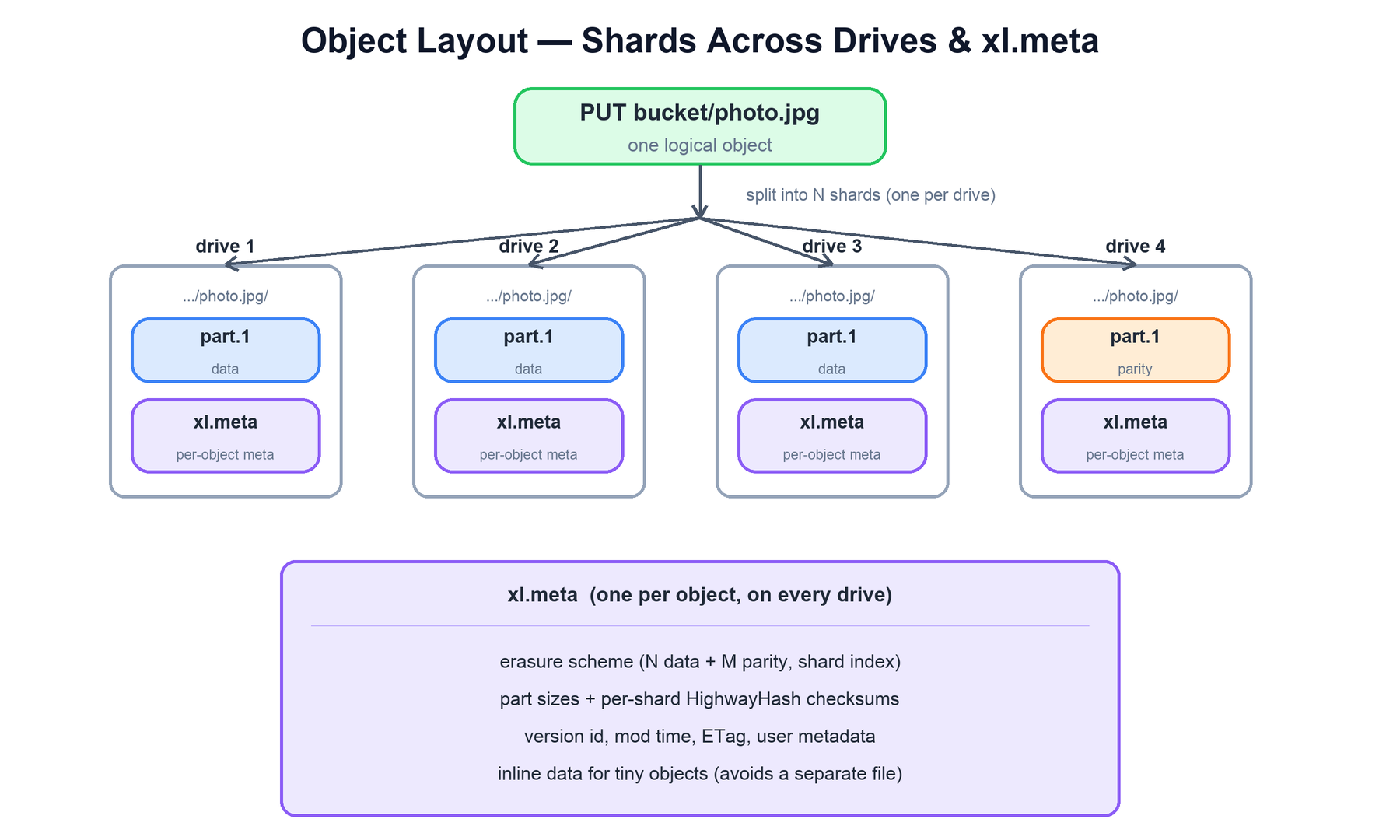
When an object is stored, MinIO does not write one file. It writes one shard part plus one metadata file on each drive of the erasure set. The shards together reconstruct the object; the metadata file describes how.
One object becomes one shard part per drive, each accompanied by an xl.meta. The metadata records the erasure scheme and per-shard checksums.
On each drive, the object occupies a directory named after its key, holding:
part.1, part.2, ...: the actual shard data for this drive (one part per object part for multipart uploads).
The metadata records coding parameters using a consistent convention: k data-equivalent shards, m parity, n=k+m total, plus shard index, part lengths, checksums, and version identity.
Keeping a copy of xl.meta on every drive means the metadata is itself protected by the same quorum as the data — there is no separate, single-point metadata store to lose. Very small objects are written inline inside xl.meta to avoid a second file open. Object versions are recorded as multiple entries inside the same xl.meta, each with its own version id and checksums.
How an object maps to drives
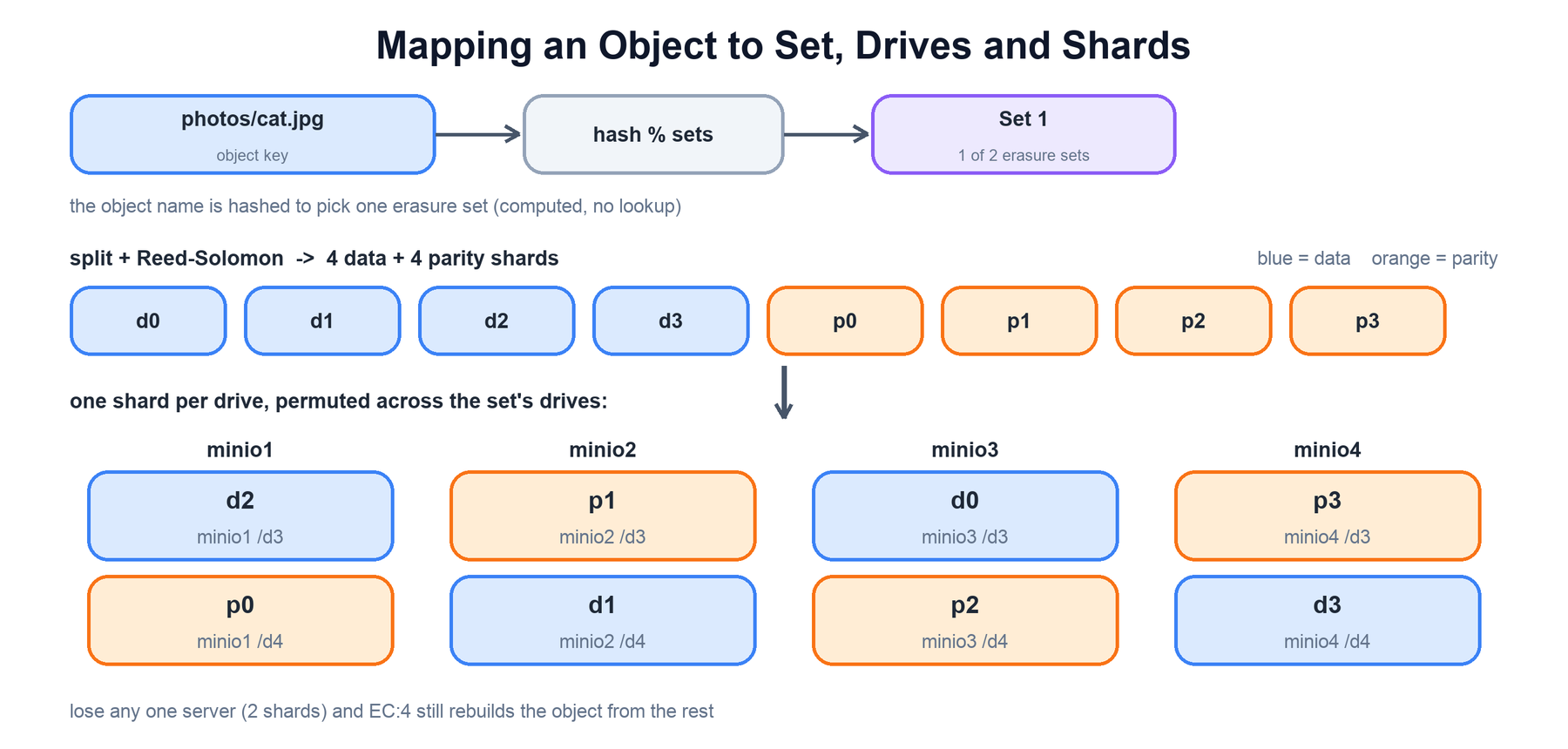
Placement is fully computed from the object name — there is no lookup table. A deterministic hash of bucket/object, modulo the number of erasure sets, picks the one set that holds the object, so the same name always resolves to the same set. The object is then Reed-Solomon split into the set's data + parity shards, and a second name-derived permutation lays exactly one shard per drive, shuffling which drives hold data versus parity so no drive becomes a permanent parity hotspot. Because both steps are pure functions of the name, any server can locate every shard with arithmetic alone.
The name hashes to an erasure set, the object is split into data + parity shards, and a name-derived permutation places one shard on each drive across servers. With EC:4, losing a whole server still leaves enough shards to rebuild.
5. Write Path (PUT)
A PUT coordinates version-safe data and metadata publication. Stream bounded chunks through the configured encoder, write shards with stable indices/checksums/version identity, and count only successfully completed compatible writes. An online drive is not proof its append/fsync succeeded.
Use the product's layout-specific write and metadata quorum/recovery rules. If completion is uncertain, a client retry may create/reuse a version according to the API; do not infer that a timeout rolled back all remote writes. Partial artifacts need recovery/cleanup under the implementation protocol.
Data and xl.meta publication is not safely reproduced by a loop that appends bytes then independently counts metadata writes. Concurrent object mutation, checksums, atomic local rename/write ordering, failure-domain placement, and stale coordinators all matter. Use reviewed server behavior rather than treating this tutorial as its implementation.
6. Read Path (GET)
A read first selects a valid committed object version using supported metadata rules. It then retrieves enough checksum-validated shards with distinct indices from that version, reconstructs missing data if necessary, and verifies expected length/integrity. Mixing newer and older shards can corrupt the result even when their count reaches k.
At least k=n−m compatible shards are the coding requirement, not 'any n data-equivalent shards'. Unreachable or corrupt shards reduce available survivors; metadata uncertainty can make a read fail despite adequate physical bytes. Repair restores redundancy only while enough valid versioned data remains.
7. Healing
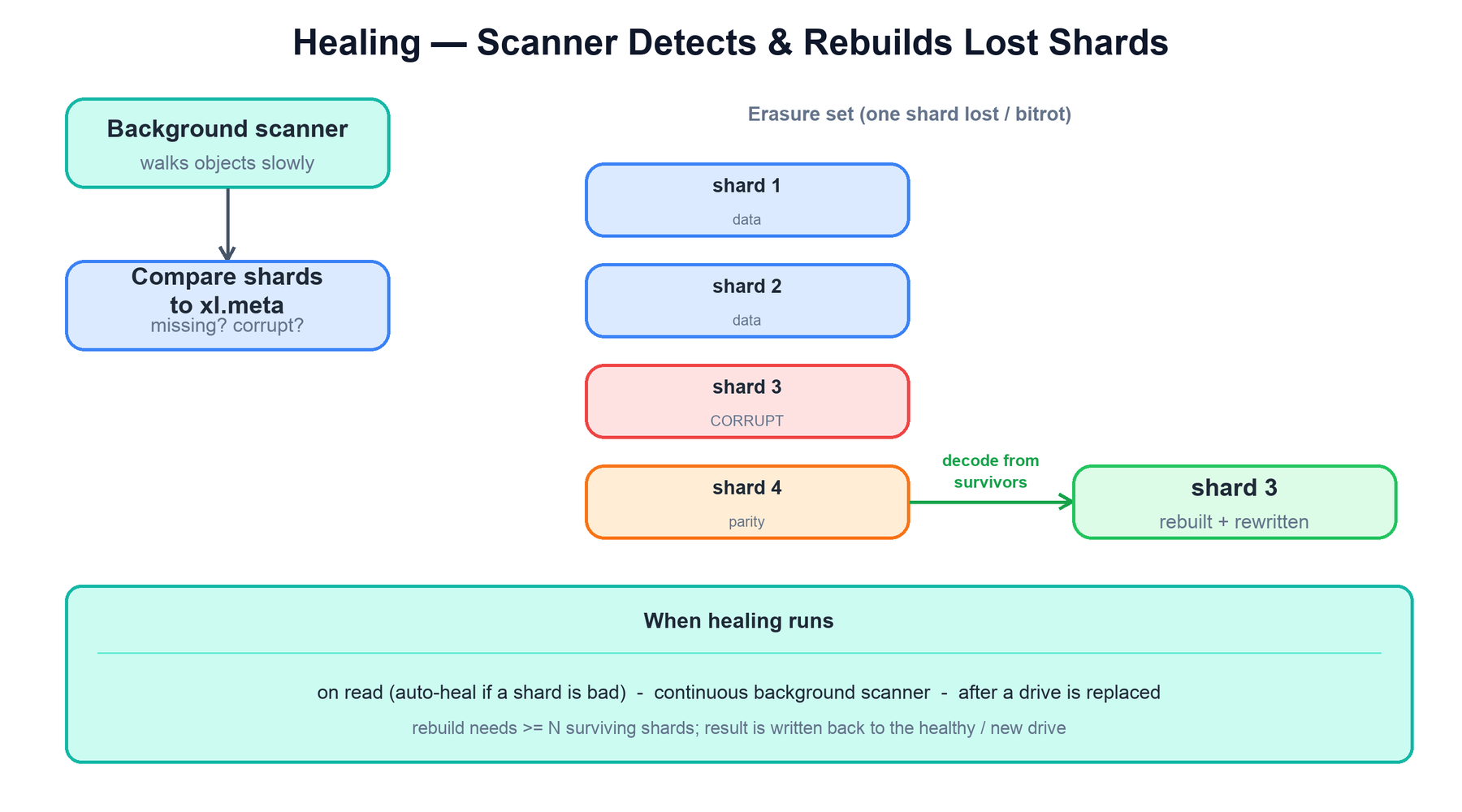
Drives fail, bits rot, and servers come and go. Healing is the process that restores the full set of shards for an object by reconstructing the missing or corrupt ones from the survivors. It is the erasure-coding analogue of repair in a replicated system.
A background scanner compares each object's shards against its xl.meta; a missing or corrupt shard is rebuilt by decoding from the surviving shards and rewritten.
Healing is detected and driven three ways:
Trigger
When it runs
What it does
Read auto-heal
During a GET
If a shard fails its checksum or is missing, MinIO reconstructs it from survivors and rewrites it to a healthy drive in the background.
Scanner
Continuous, low priority
A background scanner slowly walks every object, compares actual shards to what xl.meta says should exist, and queues anything missing or corrupt for heal.
Drive replacement
After a failed drive is swapped
The fresh, empty drive is healed: every object that should have a shard there has it reconstructed and written.
Reconstruction always uses the same Reed-Solomon decode as a read: as long as at least N−M shards survive, the missing shard's data can be regenerated and re-encoded. The healed shard is written back with a freshly computed checksum, and xl.meta is updated to mark the object whole again.
function heal(set, object):
  meta = read_quorum_xl_meta(set, object)
  N, M = meta.scheme
  good = [drive.read(object) for drive in set.drives
          if drive.is_online() and highwayhash(...) == meta.checksum[drive]]
  if len(good) < N - M:
    log_unrecoverable(object); return            # lost too many shards
  full = reed_solomon_reconstruct(good, N - M, M) # regenerate every shard
  for drive in set.drives:
    if drive_shard_missing_or_bad(drive, object):
      drive.write(object, full[drive.index])      # rewrite + checksum
      drive.update_xl_meta(object)
Because healing only touches objects whose shards are actually missing or corrupt, a replaced drive does not force the whole set offline — reads and writes continue against the surviving shards while the heal runs in the background.
8. Scaling and Replication
Use supported pool expansion and decommissioning procedures. Pool placement of new objects may be free-space-aware while set placement within a pool follows a stable mapping. Existing versions can require cross-pool lookup; do not claim the whole location is always a pure hash of the object name.
Expansion, rebalance, and decommissioning consume capacity and network I/O and can fail. Plan survivor space, reader/version lifetime, repair, and rollback; 'no downtime/no loss' is an objective under those prerequisites, not a universal result of adding a pool.
Remote bucket/site replication has its own lag, version/delete, conflict, and failover contract. Active-active availability is not global linearizability. Read/write coordination and distributed lock rules belong to the actual product implementation; quorum arithmetic alone does not protect every stale coordinator or partially written version.
Worked example: 16 shards, four lost drives
Use n=16 total shards with m=4 parity, so k=12 valid compatible shards are needed.
Sequence for this example. The table explains the evidence and decision at each step.
Step
Evidence, decision, and expected result
Encode twelve units into sixteen
Ideal stored payload is 16/12=1.333× original, or 33.3% overhead. Four parity shards are 25% of stored shards, a different denominator.
Lose four compatible shards
Twelve remain and a Reed–Solomon decoder can reconstruct. Shard identity, version, length, and validity are prerequisites.
Receive only nine write responses
Nine is a simple majority of sixteen but less than k=12. That alone cannot establish reconstructable publication. Product write quorum depends on data/parity layout and metadata rules.
Lose one server
If it held four shards, one server loss consumed the four-shard budget. The number of failed servers is not the number of lost shards.
Check your understanding: Is 'half plus one' a universal erasure write quorum?
No. The coding threshold is k=n−m; product quorum rules include metadata/version consistency. A common MinIO rule uses k, with an extra vote for a balanced data/parity layout. Verify the deployed release.
Run and change the example
Download guide_labs.py. Python 3.10+, standard library only. In its directory, run:
python3 guide_labs.py erasure
python3 guide_labs.py test
The program implements a small non-systematic Reed–Solomon code over GF(256), reconstructs from compatible survivors, and rejects an insufficient set. It does not implement MinIO. This toy code is non-systematic: its encoded shards are polynomial evaluations, not literal copies of the original data bytes. Shard IDs select equations; GF(256) arithmetic makes the chosen system invertible. Production metadata/version/integrity protocols are separate.
The program tests its stated finite contracts. It is an educational model, not an implementation of the named production product or a proof of unmodeled distributed faults.
The whole system is built from a few reinforcing ideas:
Concern
Mechanism
How do clients talk to it?
Native S3 REST API on every server; any server answers, no master.
Where does an object live?
Set placement is stable within its configured pool/mapping. Pool selection/discovery may involve free-space-aware allocation and cross-pool lookup; it is not universally name-only.
How is it kept durable?
Survives up to m shard erasures under the coding and valid-version assumptions; a server failure may remove multiple shards.
How is metadata stored?
xl.meta on every drive of the set — scheme, checksums, versions — so metadata shares the data's quorum.
How are writes consistent?
Layout-dependent write/metadata quorum: enough compatible durable shards plus the product's version/publication protocol, not a universal (n/2)+1.
How does it survive failures?
Read needs only N−M shards; healing rebuilds missing/corrupt shards from survivors; HighwayHash catches bitrot.
How does it scale & replicate?
Add pools to grow, decommission to drain; active-active bucket replication with versioning across sites.
The recurring theme: every object is self-describing and quorum-protected, durability comes from math rather than copies, and the fleet is symmetric. There is no master to lose, no metadata server to corrupt, and no rebalancing step that takes the cluster offline.