A concise, working reference to the Scrum framework — the accountabilities, artifacts, and events that let a small team deliver value in short, inspectable cycles.
Student edition · understand, apply, verify
Understand Scrum's commitments and feedback loop while separating optional estimation practices from framework requirements.
What you should be able to do: Define a goal, a usable Done Increment, and a review/adaptation cycle without turning ceremonies or velocity into the outcome.
Assumes basic programming. Define input and observable-behavior contracts before applying an algorithm or design heuristic. Pseudocode/fragments need surrounding context; the downloadable lab is complete and tested.
Scrum is the most widely used way to organize agile product work, and also one of the most widely misunderstood. Its power comes not from ceremony but from a simple loop: build a little, look at what you built, and adjust. This page is a practical reference — enough to run Scrum correctly, understand why each piece exists, and recognize the failure modes that quietly turn it back into the process it was meant to replace. It is written for people who already sit inside these meetings and want the mental model, not a tutorial.
Scrum is defined in the Scrum Guide by Ken Schwaber and Jeff Sutherland. This is an original practical summary for quick reference; see the official guide for the authoritative definition.
Read these definitions first, or use the linked terms as you go. The examples and limitations are local to this guide; companion pages are optional.
Scrum empiricism and commitments
Scrum uses transparency, inspection, and adaptation for complex product work. Product Backlog, Sprint Backlog, and Increment have Product Goal, Sprint Goal, and Definition of Done commitments.
Example. A Sprint Goal names a user outcome; a usable Increment meets shared Done criteria.
Boundary. Points and velocity are optional practices. Backlog refinement is an ongoing core activity, not a formal Scrum event.
Definition of Done versus acceptance criteria
Definition of Done is the shared quality standard for an Increment. Acceptance criteria describe an item's particular behavior.
Example. CSV export is an item criterion; shared Done includes review, tests, security/access requirements, and usability.
Boundary. Merged code is not automatically Done. Exact criteria depend on product/organization; one item does not establish the whole Increment's quality.
Outputs, outcomes, and measurement
Outputs are produced things; outcomes are changes for users/business/team. Useful metrics state definition, denominator, population, period, and attribution limits.
Example. 'Shipped a tool' is output. 'Median onboarding fell ten to six days in this cohort' is an outcome with sample/context caveats.
Boundary. Before/after does not prove sole causation. Avoid gaming, selection bias, hidden costs, and unlike-team comparisons.
Ownership, accountability, and decision rights
Ownership names who drives follow-through; accountability names who answers for outcomes. Decision rights specify who chooses/approves and who is consulted.
Example. A migration has a coordinating owner, service owners, and named release authority.
Boundary. DRI/RACI/DACI are local conventions, not guarantees. Role labels do not replace authority, capacity, and follow-through.
Stakeholders and alignment
A stakeholder is affected by or able to affect a decision. Alignment means understanding goals, constraints, tradeoffs, and the decision process; it does not require unanimous agreement.
Example. Finance values cost predictability, customers migration effort, and operations safe recovery. State these criteria before choosing.
Boundary. Consultation is not an unlimited veto. Name decision authority, required evidence, deadline, and escalation.
1. What Scrum is
Scrum is a lightweight framework for delivering value iteratively, not a step-by-step methodology. It deliberately leaves most of the "how" unspecified: it defines a small set of roles, artifacts, and events, and then trusts the team to fill in their own engineering practices. That minimalism is the point — Scrum is a container for solving complex problems where the requirements and the solution are both discovered as you go.
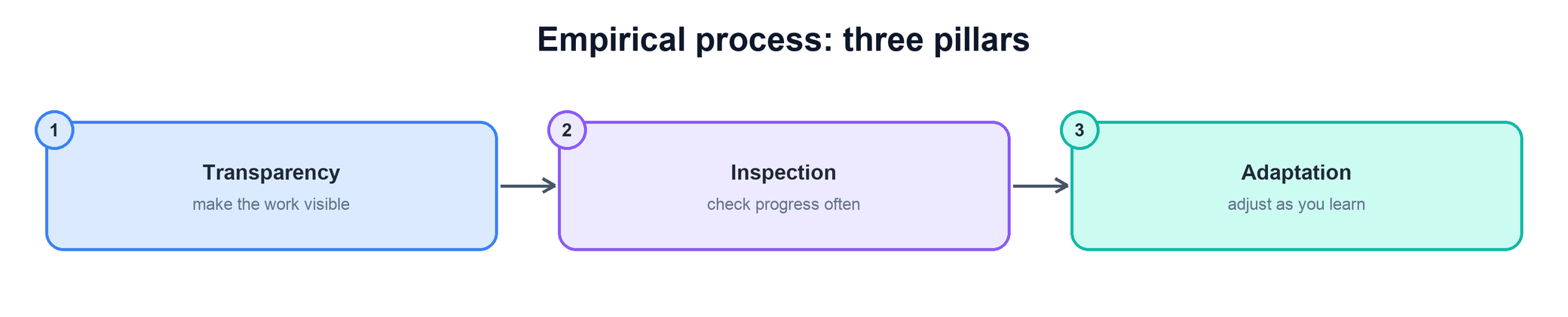
Underneath it sits empirical process control: the belief that in complex work you cannot plan your way to certainty up front, so you make decisions based on what you actually observe. Rather than predicting the whole project and executing the plan, you take a short step, measure the result against reality, and adapt. Every event and artifact in Scrum exists to feed that empirical loop, which rests on three pillars — transparency, inspection, and adaptation.
Empiricism in three moves: make the work visible, inspect it frequently, and adapt based on what you see. Remove any one and the loop breaks.
2. Three pillars & five values
The three pillars describe how empirical work stays honest. Each depends on the one before it.
Transparency — the work and its state must be visible to everyone who depends on it, in a shared understanding. You cannot inspect what you cannot see.
Inspection — artifacts and progress toward goals are examined frequently and diligently, so problems and drift are caught early rather than at the end.
Adaptation — when inspection reveals that things are off course, the process or the product is adjusted as soon as possible to minimize further deviation.
The five values describe how the team behaves so those pillars actually function. Without them, the events become empty ritual.
Commitment — the team genuinely commits to its goals and to supporting each other.
Courage — members have the courage to do the right thing and to raise hard problems.
Focus — everyone concentrates on the work of the Sprint and its goal.
Openness — the team and stakeholders are open about the work and the challenges.
Respect — members respect each other as capable, independent people.
3. The Scrum Team & accountabilities
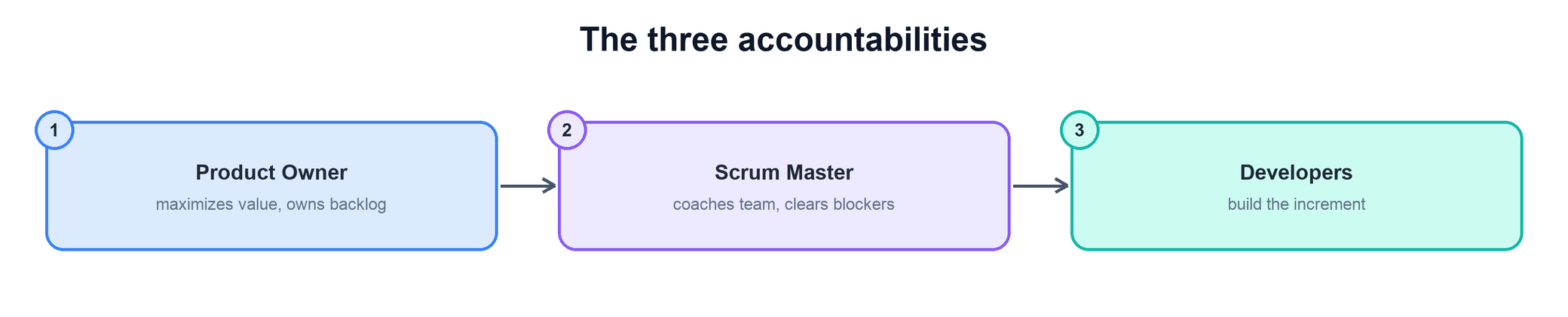
Scrum is run by one small, cross-functional, self-managing team — typically ten people or fewer — that has everything it needs to create value each Sprint. There are no sub-teams and no hierarchy inside it; instead there are three accountabilities. These are responsibilities, not job titles, and one team has exactly one Product Owner and one Scrum Master.
Product Owner — accountable for maximizing the value of the product. Owns the Product Backlog: what goes in, how it is ordered, and that it is clear and visible. A single person, not a committee.
Scrum Master — accountable for the team's effectiveness and for the way Scrum is practiced. Coaches the team toward self-management, removes impediments, and protects the process (and the team's focus) — a servant leader, not a manager.
Developers — accountable for building a usable Increment each Sprint. "Developers" means everyone doing the work of creating the product, whatever their specialty.
Three accountabilities on one team: the Product Owner points at value, the Developers build it, and the Scrum Master keeps the system healthy.
Coaching, removing impediments, guarding the framework
Developers
The Sprint Backlog and the technical work
Building a done, usable Increment every Sprint
4. Artifacts & their commitments
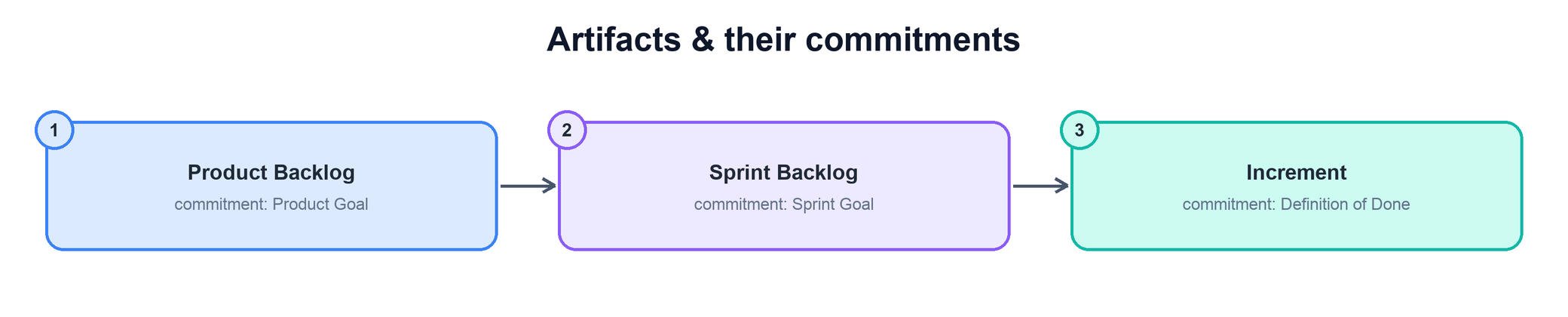
Scrum has exactly three artifacts, and each carries a matching commitment — a target that gives the artifact meaning and makes progress measurable. The commitment is what turns a list into a purpose.
Product Backlog — the single, ordered list of everything that might improve the product. Its commitment is the Product Goal: the longer-term objective the team is working toward.
Sprint Backlog — the Sprint Goal plus the selected backlog items and the plan to deliver them. Its commitment is the Sprint Goal: the single objective for the Sprint.
Increment — a concrete, usable step toward the Product Goal, added to all prior Increments. Its commitment is the Definition of Done: the shared, formal quality bar an item must meet to count as complete.
Each artifact has a commitment that makes it inspectable: Product Backlog to Product Goal, Sprint Backlog to Sprint Goal, Increment to Definition of Done.
Artifact
What it is
Commitment
Product Backlog
Ordered list of all potential product work, owned by the Product Owner
Product Goal
Sprint Backlog
The Sprint Goal, selected items, and the Developers' plan for the Sprint
Sprint Goal
Increment
A usable, integrated addition to the product that meets the quality bar
Definition of Done
5. The Sprint
The Sprint is the heartbeat of Scrum — a fixed timebox of one month or less in which a done Increment is created. Everything else happens inside it, and a new Sprint starts immediately after the previous one ends, so there are no gaps. Keeping the length fixed makes velocity and forecasting meaningful and keeps the inspect-and-adapt loop running at a steady cadence.
During a Sprint, the scope may be clarified and renegotiated with the Product Owner as more is learned, but no changes are made that would endanger the Sprint Goal. Quality does not drop. The Sprint Goal gives the team a coherent objective to protect, which is precisely why mid-Sprint churn is so corrosive: it trades a committed goal for an unstable one. Only the Product Owner has the authority to cancel a Sprint, and only if the Sprint Goal becomes obsolete.
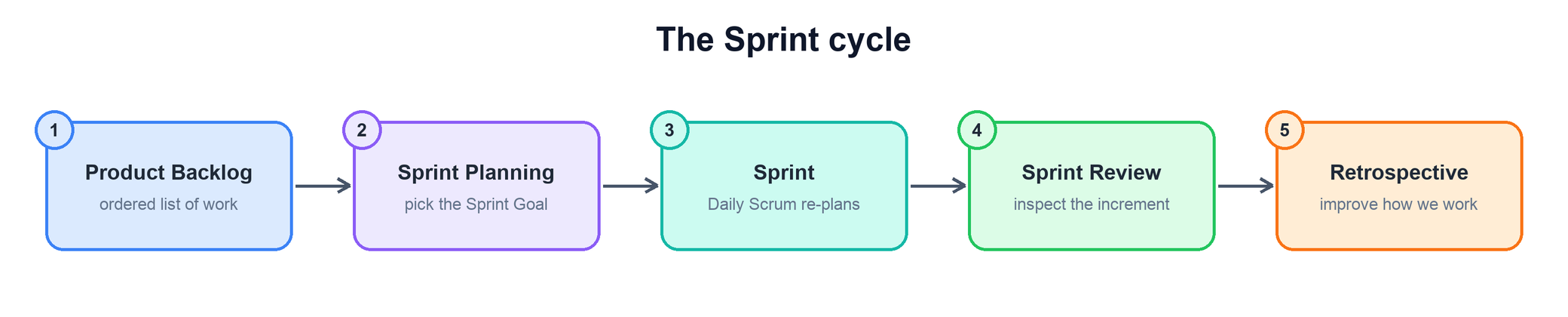
One turn of the wheel: draw from the Product Backlog, plan the Sprint Goal, do the work with a Daily Scrum, review the Increment with stakeholders, then retrospect and go again.
6. The events
The Scrum Guide gives maximum event durations for one-month Sprints and says shorter Sprints usually have shorter events. It does not prescribe a strict proportional formula; Daily Scrum remains 15 minutes.
Sprint Planning — opens the Sprint by answering three questions: why this Sprint is valuable (the Sprint Goal), what can be done, and how the chosen work will get done. The output is the Sprint Backlog.
Daily Scrum — a 15-minute event for the Developers to inspect progress toward the Sprint Goal and re-plan the day's work. It is a planning session, not a status report to a manager.
Sprint Review — the team and stakeholders inspect the Increment together, discuss what changed in the environment, and collaborate on what to do next. It is a working session, not a demo theater.
Sprint Retrospective — the team inspects how it worked — process, tools, interactions, Definition of Done — and commits to concrete improvements. It closes the Sprint.
Event
Timebox (1-month Sprint)
Purpose
Output
Sprint Planning
Up to 8 hours
Decide why, what, and how for the Sprint
Sprint Goal & Sprint Backlog
Daily Scrum
15 minutes, daily
Inspect progress and re-plan toward the Sprint Goal
An adjusted plan for the day
Sprint Review
Up to 4 hours
Inspect the Increment with stakeholders, adapt the backlog
Updated Product Backlog
Sprint Retrospective
Up to 3 hours
Inspect and improve how the team works
Concrete improvement actions
7. Backlog, estimation & flow
Distinguish required framework activities/commitments from optional techniques. Refinement is an ongoing Scrum activity, not a formal event; user stories, points, velocity, and particular boards are optional.
Backlog refinement — the ongoing activity of breaking down, clarifying, and ordering upcoming backlog items so they are ready to be pulled into a Sprint. It is continuous work, not a fixed event.
User stories — a popular format for backlog items ("As a <user>, I want <goal> so that <benefit>") that keeps items framed around user value. Just one convention among many.
Story points & velocity — a relative estimate of effort per item, and the amount of points a team completes per Sprint. Useful for forecasting; dangerous when weaponized as a productivity metric across teams.
Definition of Done — unlike the rest of this list, this is a core commitment (see the Increment). It is the shared quality bar every item must clear to be releasable.
Burndown / burnup charts — simple visualizations of remaining work over time, used to make progress transparent within a Sprint or release.
A quick test: if a practice helps your team make work transparent and adapt faster, keep it. If it survives only because "that's how we do Scrum," it is probably ceremony — the framework does not require story points, a specific board tool, or a particular estimation ritual.
8. Common anti-patterns
Most failed Scrum adoptions fail in the same handful of ways. Each of these hollows out an inspect-and-adapt loop while keeping the meeting on the calendar.
Scrum as status meeting — the Daily Scrum becomes a round-robin report to a manager instead of the Developers re-planning their own day toward the Sprint Goal.
Retrospectives are a formal opportunity to improve quality/effectiveness, alongside ongoing inspection/adaptation. Do not imply teams cannot improve during other activities.
Changing scope mid-Sprint — injecting new work that endangers the Sprint Goal, destroying the stability that makes the Sprint meaningful and forecasting possible.
Scrum Master as taskmaster — the Scrum Master assigns work and polices individuals instead of coaching the team toward self-management and clearing impediments.
No Definition of Done — without a shared quality bar, "done" means whatever each person decides, the Increment is not truly usable, and technical debt accumulates invisibly.
Water-scrum-fall — a big up-front design phase and a long release phase bookend a thin sliver of "Sprints," so the empirical loop never actually runs.
Worked example: CSV export within a two-week Sprint
Use this small example to connect the concept to a concrete decision.
Sequence for this example. The table explains the evidence and decision at each step.
Step
Evidence, decision, and expected result
Set a coherent Sprint Goal
Users can export their own authorized data. Selected backlog items form a plan toward that goal.
Define quality and item behavior
Acceptance: a correct CSV for an eligible user. Done: tests, access controls, integration, review, and deployability under the team standard.
Inspect and adapt daily
Developers adjust the plan when blocked. They can renegotiate scope without endangering the goal or lowering quality.
Review the usable Increment
Collect user/stakeholder evidence and revise backlog; retrospect on how the team worked. Story points are not proof of value.
Check your understanding: Is refinement an optional practice just like story points?
No. Product Backlog refinement is an ongoing activity described by Scrum; it is not one of the formal events. Story points/velocity are optional conventions.
Run and change the example
Download guide_labs.py. Python 3.10+, standard library only. In its directory, run:
python3 guide_labs.py metrics
python3 guide_labs.py test
The metrics lab shows why output counts and changing denominators can mislead; Scrum practice itself is the worked situation, not something Python certifies.
The program tests its stated finite contracts. It is an educational model, not an implementation of the named production product or a proof of unmodeled distributed faults.
Strip Scrum to its essentials and it is a short, repeating loop with a small team and a clear goal:
Element
The one-line takeaway
Empiricism
Plan a little, build a little, inspect, and adapt — certainty is discovered, not forecast.
The team
One small, cross-functional, self-managing team with three accountabilities.
Artifacts
Product Backlog, Sprint Backlog, Increment — each anchored by a commitment.
The Sprint
A fixed timebox that protects a single Sprint Goal and delivers a done Increment.
The events
Planning, Daily Scrum, Review, Retrospective — four chances to inspect and adapt.
Practices vs. framework
Stories, points, and burndowns help, but they are not Scrum — don't confuse them for it.
The recurring theme: Scrum's value is the inspect-and-adapt loop, not the ceremonies. Every event exists to make work transparent and to change course based on reality — keep the loop honest and the rest follows; hollow it out and you are left with expensive meetings.