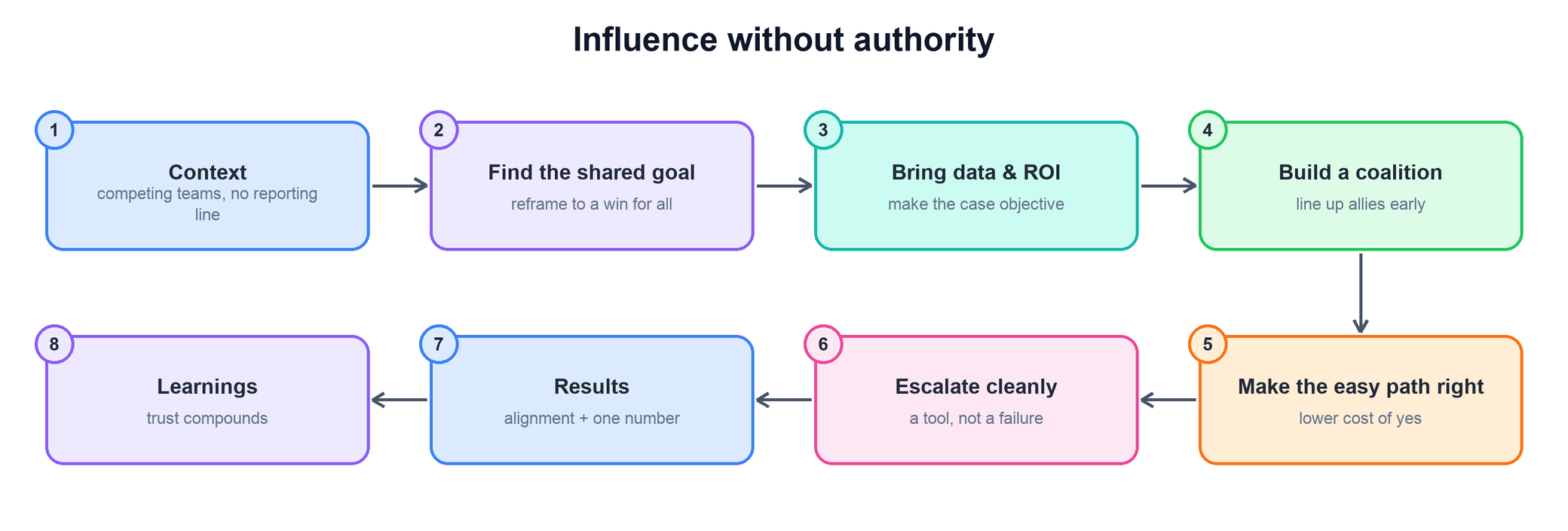
Driving alignment across teams with competing priorities when no one reports to you.
Student edition · understand, apply, verify
Build legitimate cross-team support through value, evidence, lower friction, and clear escalation.
What you should be able to do: Respect partner priorities and make a proposed joint outcome inspectable without relying on personal pressure.
Context-dependent collaboration guidance. Examples/numbers are illustrative; first-person practice drafts are not verified personal history. Respect decision rights, safety/legal obligations, privacy, and the partners' actual capacity. No framework guarantees agreement or delivery.
Concepts explained in this guide
Read these definitions first, or use the linked terms as you go. The examples and limitations are local to this guide; companion pages are optional.
Stakeholders and alignment
A stakeholder is affected by or able to affect a decision. Alignment means understanding goals, constraints, tradeoffs, and the decision process; it does not require unanimous agreement.
Example. Finance values cost predictability, customers migration effort, and operations safe recovery. State these criteria before choosing.
Boundary. Consultation is not an unlimited veto. Name decision authority, required evidence, deadline, and escalation.
Opportunity cost and prioritization
Opportunity cost is benefit forgone by choosing one investment over another. Compare expected value, effort, uncertainty, constraints, and dependencies under finite capacity.
Example. A feature can delay reliability work; compare user benefit with risk reduction and explain the choice.
Boundary. ROI/RICE/weighted scoring are aids, not exact laws. Units, uncertainty, mandatory constraints, and critical paths can dominate scores.
Ownership, accountability, and decision rights
Ownership names who drives follow-through; accountability names who answers for outcomes. Decision rights specify who chooses/approves and who is consulted.
Example. A migration has a coordinating owner, service owners, and named release authority.
Boundary. DRI/RACI/DACI are local conventions, not guarantees. Role labels do not replace authority, capacity, and follow-through.
Decision records and reversible experiments
Record the problem, options, evidence, constraints, owner, chosen tradeoff, and reconsideration trigger. A reversible test reduces uncertainty before large commitment.
Example. Try one tenant with success/abort metrics and a data-safe rollback plan.
Boundary. Timeboxing does not bypass compliance/safety. Reversible means effects and data can actually recover, not merely that a flag exists.
Outputs, outcomes, and measurement
Outputs are produced things; outcomes are changes for users/business/team. Useful metrics state definition, denominator, population, period, and attribution limits.
Example. 'Shipped a tool' is output. 'Median onboarding fell ten to six days in this cohort' is an outcome with sample/context caveats.
Boundary. Before/after does not prove sole causation. Avoid gaming, selection bias, hidden costs, and unlike-team comparisons.
This question tests whether you can move an organization you don’t control. As a senior engineering leader — especially in a horizontal infra role like ads events storage, where every product team is a dependency and none is a report — most of your leverage comes from persuasion, not position. The interviewer wants to see that you get outcomes by aligning incentives, marshalling data, and building coalitions, and that you treat escalation as a tool you use deliberately, not as an admission that your influence failed. The answer is built on the CARL shape — Context, Actions, Results, Learnings — with most of your words on the moves only you made.
The spine: find the shared goal → bring data and ROI → build a coalition → make the easy path the right path → escalate cleanly when stuck → land a measurable result.
What this question is really testing
Can you get competing teams to do something that helps the whole without the authority to order it — and do it in a way that leaves those relationships stronger, not spent.
How to answer
Reframe to a shared goal. Start by finding the outcome every team already wants — reliability, cost, launch velocity — and show how your ask is the path to their win, not a tax you’re levying on their roadmap.
Lead with data and ROI. Replace “please prioritize this” with a number: the incident hours saved, the CPU or storage dollars freed, the latency regression avoided. Objective evidence is the currency that buys priority you can’t command.
Build a coalition before the big room. Line up the influential allies — a respected tech lead, the partner PM, a friendly director — one conversation at a time, so the proposal walks into the review already supported rather than being litigated live.
Make the easy path the right path. Lower the cost of “yes” to near zero: ship the migration tooling, do the integration work yourself, provide the default config. Teams adopt what’s frictionless and resist what’s homework.
Escalate as a tool, not a failure. When a genuine priority conflict can only be resolved above you, take a crisp, data-backed decision to the shared manager with the other party, framed as “we need a tiebreak,” not “they’re blocking me.” Clean escalation preserves the relationship; a surprise ambush destroys it.
What the interviewer is looking for
Outcomes achieved through incentives and evidence, not title or volume.
Empathy for the other team’s priorities — you understood their world before asking them to change it.
Coalition-building and pre-wiring, not a single heroic pitch.
Escalation used cleanly and rarely — a deliberate instrument, not a tantrum.
Relationships intact or stronger afterward, because you’ll need them again.
A worked example (CARL)
Practice draft: first-person narratives below are not independently verified autobiographical evidence. Use their structure, not their claimed results; replace with your genuine safe-to-share experience.
Context. Our ads events storage tier was carrying a fast-growing, low-value log stream that three product teams wrote to by default. It was on track to blow our storage budget by roughly 30% for the half, but none of the three teams owned the cost, and each had a packed roadmap. I owned the platform’s efficiency goal; I owned none of the three teams.
Actions. I started by refusing to make it a cost argument aimed at them — that just moves a problem they don’t feel onto their backlog. Instead I pulled the data and reframed the shared goal: I showed each team that the same low-value writes were also inflating their read latency and their own on-call query times, so trimming the stream was a reliability and developer-experience win they already wanted. I built the case in Scuba — per-team write volume, the dollar cost attributable to each, and the p99 latency they’d each recover — so the conversation ran on numbers, not opinions. Before proposing anything broadly, I pre-wired a coalition: I walked the analysis one-on-one to the most respected tech lead among the three and to the partner PM who owned the roadmap tradeoff, and got them nodding before any group review. Then I attacked the cost of “yes”: rather than asking each team to do migration work, my team built a schema-sampling config and a one-line opt-in, and I offered to send the diffs myself so their side was a review, not a project. Two teams adopted within the sprint. The third had a genuine conflict — a launch that depended on full-fidelity logs for another month. I didn’t try to steamroll them; I took a crisp, one-page decision doc to our shared director with that team’s lead in the room, framed as “here are two reasonable priorities in tension, we need a call on timing,” and we got a dated exception instead of a standoff.
Results. The write volume on that stream dropped by about 60% within six weeks, we came in under the storage budget for the half instead of 30% over, and the two adopting teams saw a measurable p99 read-latency improvement they hadn’t asked for but happily took. No relationship was bruised — the team we escalated on came back the next quarter to adopt the same sampling voluntarily.
Learnings. Influence is mostly upstream work: the reframe, the data, and the coalition happen before the ask. And escalation, done with the other party and backed by a decision doc, is a partnership move, not a hostile one — it’s how you get a fast decision without spending the relationship.
Common follow-ups
What if you can’t find a shared goal — the other team just doesn’t care?
How to answer
Dig for the real incentive. “Doesn’t care” usually means you haven’t connected your ask to what they’re measured on — find their goal and map to it.
Reduce the cost to near zero. If you can’t raise their motivation, lower the effort until saying yes is cheaper than saying no.
Find the higher shared goal. Escalate the framing to the org objective both teams answer to, so the priority is set where it should be.
Know when to escalate for a decision. If it’s a real priority conflict, that’s a leadership call — surface it cleanly rather than grinding.
How do you avoid escalation being seen as going over someone’s head?
How to answer
No surprises. Tell the other party you’re going to escalate and why, before you do — ideally escalate together.
Escalate the decision, not the person. Frame it as “two good priorities in tension, we need a tiebreak,” not “they’re blocking me.”
Bring options, not a complaint. Walk in with a crisp doc and a recommendation so leadership decides fast.
Commit to the outcome. Whichever way it goes, get behind it publicly — that’s what makes escalation safe to use again.
How is influencing peers different from influencing up to leadership?
How to answer
Peers need incentive alignment. They have their own roadmaps, so the win has to be theirs too — ROI and low friction do the work.
Leaders need the decision framed. Give them the tradeoff, the recommendation, and the cost of inaction in one page; respect their time.
Both need trust and track record. Credibility from prior delivery is what makes the next ask land, up or across.
Match altitude to audience. Peers want mechanism; leaders want impact and risk — tell the same story at the right resolution.
What if the same friction with a team keeps recurring no matter how you influence it?
How to answer
Suspect the structure, not the people. Recurring friction between two teams is often Conway’s Law showing through — the org chart is fighting the architecture, and no amount of goodwill fixes a boundary drawn in the wrong place.
Name the real seam. Map where the ownership line cuts across a dependency; the standing conflict usually lives exactly on that seam.
Propose the structural fix. The durable answer is sometimes moving ownership, merging a surface, or redrawing an interface — a one-time change that dissolves the conflict instead of re-mediating it every quarter.
Escalate it as a design problem. Frame it to leadership as an architecture-and-ownership question, not an interpersonal one, so the fix lands where the cause actually is.
Evidence to collect with your approved tools
A decision/review record with the problem, constraints, options, and your contribution.
Relevant tests, dashboards, or measurements with definitions, denominators, dates, and uncertainty.
Incident or delivery records showing actual outcomes and unresolved limitations.
Stakeholder agreements and follow-up actions with owners and review dates.
Only authorized, minimized, safe-to-share evidence. Do not copy confidential personnel notes into a public story.
Worked example: a partner team cannot spare migration capacity
Use the following scenario to practice making goals, uncertainty, responsibility, and evidence explicit.
Sequence for this example. The table explains the evidence and decision at each step.
Step
Evidence, decision, and expected result
Understand its commitments
Ask what work is displaced and which dependencies or constraints block participation.
State mutual value
Compare the benefit and full migration/support cost in the partner's workflow.
Offer bounded support
Provide tested tooling, integration help, a pilot, and realistic milestones rather than promising zero effort.
Resolve priority openly
If capacity still conflicts, bring options/recommendation jointly to the decision owner; do not use hidden pressure or surprise escalation.
Check your understanding: Does technical superiority alone create adoption?
Choose a real cross-team decision. Record the shared problem, each party's constraints, options, assumptions, authority, agreed actions, owner/date, observed outcome, and reconsideration trigger. Use authorized evidence and distinguish contribution from attribution.
Use genuine, safe-to-share evidence. Example numbers here illustrate reasoning; they are not claims about your work or a guaranteed outcome.