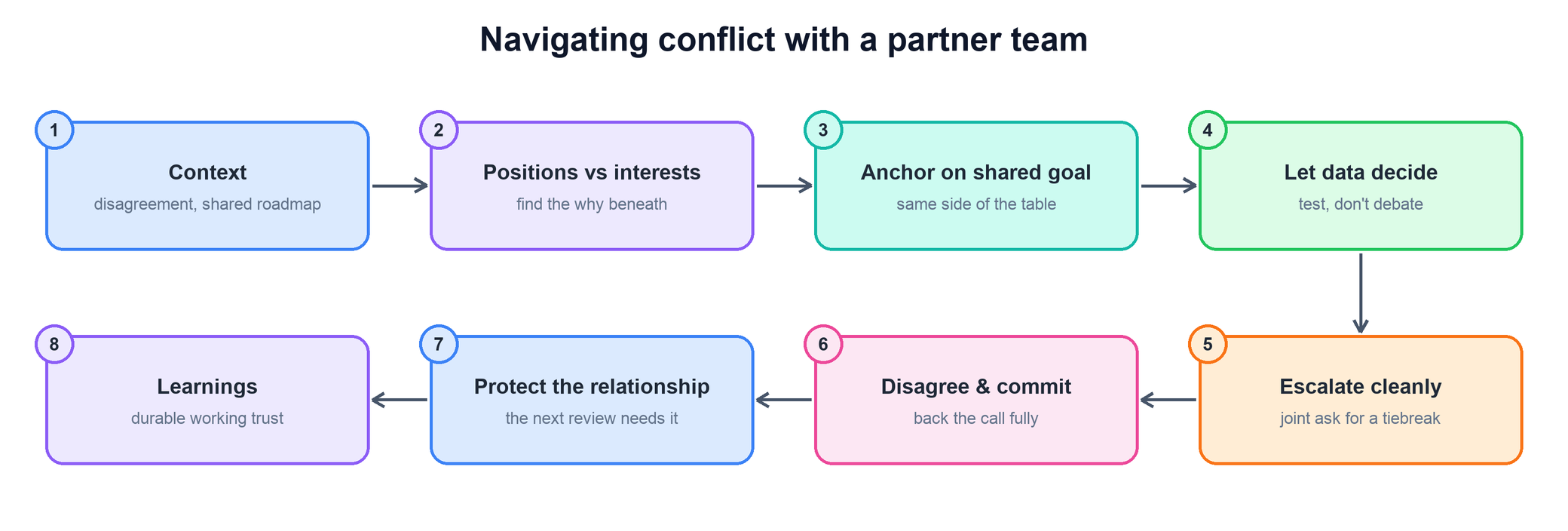
Turning a disagreement into a decision — whether you’re a party to the conflict or the neutral broker between two powerful stakeholders — without spending the relationship.
Student edition · understand, apply, verify
Resolve stakeholder conflict by examining interests, constraints, and explicit decision authority.
What you should be able to do: Create alternatives and a fair process without assuming every tradeoff can be eliminated.
Context-dependent collaboration guidance. Examples/numbers are illustrative; first-person practice drafts are not verified personal history. Respect decision rights, safety/legal obligations, privacy, and the partners' actual capacity. No framework guarantees agreement or delivery.
Concepts explained in this guide
Read these definitions first, or use the linked terms as you go. The examples and limitations are local to this guide; companion pages are optional.
Stakeholders and alignment
A stakeholder is affected by or able to affect a decision. Alignment means understanding goals, constraints, tradeoffs, and the decision process; it does not require unanimous agreement.
Example. Finance values cost predictability, customers migration effort, and operations safe recovery. State these criteria before choosing.
Boundary. Consultation is not an unlimited veto. Name decision authority, required evidence, deadline, and escalation.
Decision records and reversible experiments
Record the problem, options, evidence, constraints, owner, chosen tradeoff, and reconsideration trigger. A reversible test reduces uncertainty before large commitment.
Example. Try one tenant with success/abort metrics and a data-safe rollback plan.
Boundary. Timeboxing does not bypass compliance/safety. Reversible means effects and data can actually recover, not merely that a flag exists.
Ownership, accountability, and decision rights
Ownership names who drives follow-through; accountability names who answers for outcomes. Decision rights specify who chooses/approves and who is consulted.
Example. A migration has a coordinating owner, service owners, and named release authority.
Boundary. DRI/RACI/DACI are local conventions, not guarantees. Role labels do not replace authority, capacity, and follow-through.
Psychological safety and constructive conflict
A shared belief that asking questions, reporting mistakes, or disagreeing can happen without humiliation or retaliation. It supports learning alongside clear standards.
Example. A junior engineer reports a suspected fault early; the lead examines evidence instead of attacking the person.
Boundary. It does not mean universal comfort/agreement or no accountability. Power, incentives, and context shape who can speak safely.
STAR and CARL interview structure
STAR means Situation, Task, Action, Result. CARL means Context, Action, Result, Learning. They distinguish conditions, responsibility, personal decisions, and outcomes.
Example. Describe the team's problem, your role, what you personally changed, and measured results; add a tradeoff and learning.
Boundary. Use genuine safe-to-share evidence. A framework does not authorize invented achievements or someone else's story.
This question comes in two modes, and a strong answer handles both. In the first, you are a party to the conflict — a roadmap disagreement, an ownership dispute, or a clash with a partner PM over what to build. In the second, you are the broker: two powerful stakeholders (say, Security vs. Developer Velocity) have flatly conflicting requirements for a shared platform, and you have to resolve the deadlock without being captured by either side. Both share the same spine — get beneath positions to interests, reframe around a shared goal, let evidence decide, and drive to a durable call. The interviewer isn’t looking for someone who avoids conflict or wins it; they want someone who resolves it on the merits and comes out with the relationship intact, because you’ll be working with these people again next quarter. Answer in the CARL shape — Context, Actions, Results, Learnings, most of your words on the Actions — and it’s judged on maturity: separating positions from interests, letting data decide, escalating cleanly, and genuinely disagreeing-and-committing.
The spine: separate positions from interests → anchor on the shared goal → let data decide → escalate cleanly for a tiebreak → disagree and commit → protect the relationship.
What this question is really testing
When you’re a party: can you disagree hard on substance while staying easy on the person — getting to a sound decision without turning a colleague into an adversary? When you’re the broker: can you hold genuine neutrality and still be decisive — forcing a call on a clock while both sides trust you aren’t captured? In both modes the best resolution is usually not a compromise along the axis of conflict but a third option that dissolves the tradeoff, which only comes from understanding the underlying interests deeply.
How to answer
Understanding interests can reveal alternatives, but some constraints genuinely conflict. Test options and use explicit decision authority for the remaining tradeoff.
Anchor on the shared goal. Move from “my proposal vs yours” to “us vs the problem.” Get everyone to agree, out loud, on the one outcome they both answer to — a platform that is safe and fast enough to adopt — and make that the tiebreaker for every downstream choice.
Let data and agreed criteria decide. Where you can, convert an argument into a measurement — a benchmark, a prototype, a cost model — and, before debating solutions, agree how you’ll judge options (risk reduced, latency added, developer friction, cost). Evidence and criteria depersonalize the disagreement and move it off ego and rank onto the merits.
When you’re the broker, surface each side’s real constraints first. Meet each powerful stakeholder separately to get past the stated demand to the non-negotiable underneath, then steel-man both positions in the room so neither side thinks you’re captured — and if you hold an opinion, declare your bias and then let the criteria carry the verdict.
Propose an option that meets both non-negotiables; escalate only on a clean tradeoff. Generate options that dissolve the tradeoff — a tiered policy, automated guardrails instead of manual gates, a default-safe path with an audited fast lane — so nobody simply loses. If it’s truly deadlocked, take it up together as a crisp either/or with your recommendation attached — escalate to ratify, never to hand off the thinking or ambush the other party.
Disagree and commit, and protect the relationship. Once a decision is made — your way, theirs, or the broker’s recommendation — get everyone fully behind it and say so publicly. Classify the call as reversible or not, name a DRI, and end on terms that make the next hard conversation start from trust rather than scar tissue.
What the interviewer is looking for
Interests surfaced beneath positions — not a battle of demands, side-picking, or split-the-difference.
Disagreement reframed as a shared problem, with a shared goal established before any solutioning.
Data and objective, agreed criteria used to depersonalize and settle the choice.
Creative third options that dissolve rather than split the tradeoff.
Genuine neutrality as a broker — both sides trust you’re not captured — with decisiveness on a clock.
Clean, joint escalation used to ratify not abdicate — and genuine disagree-and-commit that preserves the relationship.
A worked example (CARL)
Practice draft: first-person narratives below are not independently verified autobiographical evidence. Use their structure, not their claimed results; replace with your genuine safe-to-share experience.
Context. A partner PM on an ads measurement team wanted my storage team to add a new low-latency read path for a launch on an aggressive timeline. I believed the design they were pushing — a synchronous fan-out read against our hot store — would risk our write-path reliability under peak load and put an SLA we owned at risk. They saw my pushback as infra slowing their launch; I saw their ask as trading my reliability budget for their deadline. It was getting tense in reviews.
Actions. I first took the heat out of it by getting off the position and onto the interest. In a 1:1 with the PM, I asked what they actually needed — and it turned out the true requirement wasn’t “synchronous reads,” it was “measurement fresh enough that the launch dashboard looks right within a few minutes.” That reframed everything: their interest was freshness, not the specific mechanism, and our interest was protecting the write path. Those two interests weren’t actually in conflict. Then I made the disagreement about data instead of opinion. Rather than argue the reliability risk in the abstract, my team ran a quick load test of their proposed synchronous path in a shadow environment and pulled the projected write-path latency degradation from Scuba — it showed the p99 regression I was worried about was real. But we also prototyped a second option: an async materialized view that refreshed every couple of minutes, which met their freshness bar without touching the hot write path. I brought both options, with the numbers, to a joint review framed as “here’s what we both need and here are two ways to get there.” The data made the choice obvious to everyone in the room, including the PM — the async view. On the one point where we still disagreed (they wanted a tighter refresh SLA than I thought was safe for the half), I didn’t dig in; we took that single sub-question to our shared director as a crisp either/or, got a call in a day, and I committed to it fully even though it wasn’t my first choice.
Results. The launch shipped on its original timeline on the async path, our write-path SLA held with no regression, and we avoided a synchronous dependency that would have been a reliability liability for years. Just as important, the PM and I came out as closer partners — they brought the next two designs to my team early, in the design phase, instead of arriving with a fixed solution.
Learnings. Most “conflicts” are really two correct interests hidden behind two incompatible positions — find the interests and a third option usually exists. Data resolves the technical half; disagree-and-commit resolves the rest. And how you handle the disagreement determines whether the next one starts from trust or from scar tissue.
Common follow-ups
Two powerful stakeholders want opposite things from your shared platform and neither will move. What do you do?
How to answer
Get past positions to non-negotiables, one side at a time. Meet each separately — Security may not need manual review, only provable auditability; Velocity may not need zero controls, only same-day self-serve onboarding.
Fix the shared goal and the criteria before any solution. Get both to agree out loud on the outcome (adoptable and defensible) and on how you’ll score options — audit coverage, time-to-onboard, friction, cost — so proposals compete on evidence, not rank.
Design a third option that dissolves the tradeoff. A tiered model — self-serve automated guardrails for the common case, a lightweight audited path for sensitive producers — meets both non-negotiables so nobody just loses.
Drive to a decision with an owner and a clock. Score the recommendation against the agreed criteria, get both leads to sign, then take it up only to ratify — name a DRI and set the date so it can’t drift.
How do you stay a neutral broker when you have your own opinion?
How to answer
Declare your bias, then bracket it. Name your lean openly so both sides know it, then commit to judging by the shared criteria, not your preference.
Let the criteria carry the verdict. If the evidence points where you leaned, it’s the data’s call now, not yours — and if it points the other way, follow it visibly.
Argue the other side’s case yourself. Steel-manning each position in the room proves you’re not captured and surfaces hidden interests.
Separate facilitator from advocate. If you must advocate strongly, hand facilitation to a neutral third party so the process stays trusted.
What if the other person makes it personal or negotiates in bad faith?
How to answer
Stay on the merits. Refuse to mirror it — keep bringing the conversation back to the shared goal and the data.
Address the behavior privately. Name the pattern directly in a 1:1, calmly and with specifics, rather than fighting it in public.
Put it in writing. Summarize decisions and commitments in a doc so good-faith is the recorded default and drift is visible.
Escalate the pattern if it persists. Bad-faith partnership is a leadership problem worth surfacing — with examples, not adjectives.
You disagreed and committed — and it turned out you were right. Now what?
How to answer
Don’t gloat. “I told you so” buys nothing and costs the relationship — skip it.
Run a blameless review. Focus on what signal was missed and how the decision process can improve, not on who was wrong.
Bank the credibility quietly. Being right and gracious is what makes your next disagreement carry more weight.
Fix the system. If the wrong call was avoidable, add the check or data that would have surfaced it earlier.
How do you decide when to escalate versus keep working it?
How to answer
Escalate on genuine deadlock, not discomfort. If more discussion won’t change the inputs and the delay has real cost, it’s time.
Exhaust data first. Escalate only once you’ve tried to settle it on evidence — leaders shouldn’t arbitrate what a benchmark could.
Escalate together, with options. A joint, framed decision request gets a fast, durable call; a one-sided complaint gets a mess.
Set a clock. Agree on a decision deadline so “keep working it” doesn’t become a silent stall.
Evidence to collect with your approved tools
A decision/review record with the problem, constraints, options, and your contribution.
Relevant tests, dashboards, or measurements with definitions, denominators, dates, and uncertainty.
Incident or delivery records showing actual outcomes and unresolved limitations.
Stakeholder agreements and follow-up actions with owners and review dates.
Only authorized, minimized, safe-to-share evidence. Do not copy confidential personnel notes into a public story.
Worked example: auditability versus onboarding speed
Use the following scenario to practice making goals, uncertainty, responsibility, and evidence explicit.
Sequence for this example. The table explains the evidence and decision at each step.
Step
Evidence, decision, and expected result
Separate positions from interests
One group asks for every-write manual review; another asks for same-day onboarding. Ask what risks/outcomes those positions protect.
Agree criteria
Define audit evidence, approval authority, latency/cost limits, and exceptions.
Evaluate alternatives
Compare tested automated controls, scoped permissions, or tiered review. A new 'third option' may or may not meet both constraints.
Decide or escalate jointly
When a tradeoff remains, bring evidence/options to the proper owner; document dissent and review triggers.
Check your understanding: Must a good resolution satisfy every stakeholder demand?
No. Some constraints conflict. Explain the legitimate tradeoff and authorized decision rather than promising a universal win-win.
Practice with your own situation
Choose a real cross-team decision. Record the shared problem, each party's constraints, options, assumptions, authority, agreed actions, owner/date, observed outcome, and reconsideration trigger. Use authorized evidence and distinguish contribution from attribution.
Use genuine, safe-to-share evidence. Example numbers here illustrate reasoning; they are not claims about your work or a guaranteed outcome.