Thinking, Fast and Slow — Concepts and Practical Examples
An independent study guide to the author's ideas, their practical use, and their limitations.
Student edition · understand, apply, verify
Use heuristics and statistical thinking to question confident stories without turning bias labels into universal explanations.
What you should be able to do: Explain the main idea in your own words, apply it to a concrete situation, and state what the framework/evidence does not establish.
Original study summary, not a replacement for the book or a universal workplace policy. Distinguish the author's framework, illustrative examples, and empirical evidence. Effects depend on context; preserve dignity, safety, and appropriate privacy.
The book is a lifetime of research distilled into one argument: much of what we call “thinking” is not deliberate reasoning at all but a fast, automatic machinery that runs beneath awareness and is usually right — until it is confidently, systematically wrong. Kahneman gives that machinery a name, shows the recurring ways it errs, and connects those errors to how we judge, choose, and remember. What follows is a summary of the core ideas in my own words, meant as a study aid; the full book is worth reading for the experiments and the data behind every claim.
This is an original high-level summary written for personal study. All concepts and terminology are the work of the author; read the book for the experiments, data, and depth behind each idea.
Read these definitions first, or use the linked terms as you go. The examples and limitations are local to this guide; companion pages are optional.
System 1, System 2, and evidence limits
Kahneman uses fast automatic and slower deliberate thinking as explanatory characters. They help discuss heuristics and checking, not literal isolated brain modules.
Example. An alarming incident can dominate a risk estimate; compare its vividness with actual base rates, severity, and uncertainty.
Boundary. Bias labels do not diagnose an individual. Broad social-priming findings include disputed replication, and loss-aversion magnitudes are not a fixed universal 2× constant.
Frameworks versus empirical evidence
A framework organizes thinking; it is not automatically a validated causal law. Evidence needs study design, uncertainty, effect size, population, and replication context.
Example. Growth-mindset practices can help in some settings without making effort alone determine outcomes. Examine structural barriers and actual results.
Boundary. Popular books simplify behavioral/neuroscience findings. Priming or a named model is not a guaranteed workplace intervention.
Decision records and reversible experiments
Record the problem, options, evidence, constraints, owner, chosen tradeoff, and reconsideration trigger. A reversible test reduces uncertainty before large commitment.
Example. Try one tenant with success/abort metrics and a data-safe rollback plan.
Boundary. Timeboxing does not bypass compliance/safety. Reversible means effects and data can actually recover, not merely that a flag exists.
Outputs, outcomes, and measurement
Outputs are produced things; outcomes are changes for users/business/team. Useful metrics state definition, denominator, population, period, and attribution limits.
Example. 'Shipped a tool' is output. 'Median onboarding fell ten to six days in this cohort' is an outcome with sample/context caveats.
Boundary. Before/after does not prove sole causation. Avoid gaming, selection bias, hidden costs, and unlike-team comparisons.
Opportunity cost and prioritization
Opportunity cost is benefit forgone by choosing one investment over another. Compare expected value, effort, uncertainty, constraints, and dependencies under finite capacity.
Example. A feature can delay reliability work; compare user benefit with risk reduction and explain the choice.
Boundary. ROI/RICE/weighted scoring are aids, not exact laws. Units, uncertainty, mandatory constraints, and critical paths can dominate scores.
1. Two systems
Kahneman uses System 1 (fast/automatic) and System 2 (deliberate/effortful) as explanatory characters for cognitive processes. They are not literal isolated brain modules, and 'lazy' is a narrative shorthand rather than a universal metabolic diagnosis.
Heuristics can be useful or misleading depending on task, expertise, evidence, and incentives. Deliberation is not automatically unbiased. Use the distinction to motivate checking assumptions, base rates, and uncertainty, not to label a colleague's mind.
2. How System 1 gets us in trouble
System 1’s job is to build a coherent story from whatever is in front of it, and it is remarkably good at that — too good. Kahneman coins the phrase WYSIATI: “what you see is all there is.” System 1 does not account for information it does not have; it builds the best possible story from the evidence at hand and does not flag how thin that evidence might be. Confidence comes from the coherence of the story, not from the amount or quality of the data behind it. This is why we can hold strong opinions on the flimsiest of facts.
Several related tendencies make things worse:
Cognitive ease. When something is easy to process — clearly printed, repeated, rhymed, familiar — it feels true, good, and safe. Fluency is mistaken for truth. Making a message easy to read literally makes people more likely to believe it.
Priming. Prior exposure can influence processing in specific tasks; semantic/perceptual priming differs from broad social-behavioral priming. Several prominent social-priming findings have disputed replication, so do not generalize them into guaranteed workplace effects.
Substitution is one useful explanatory pattern, not a proved single root of every cognitive bias.
3. Heuristics & biases
Heuristics trade speed and accuracy under particular tasks; there is no universal 90%-success/10%-failure rate.
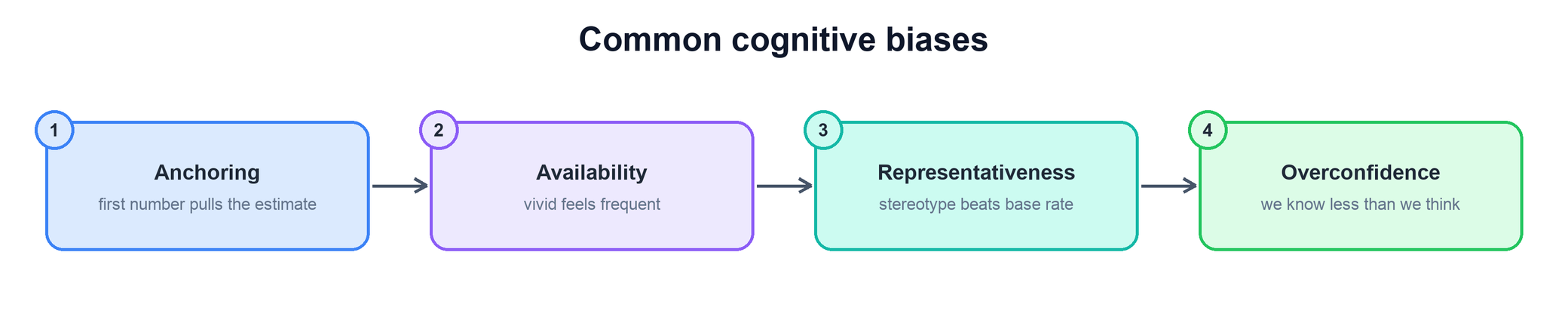
A few of the recurring shortcuts: an anchor pulls estimates, vivid events feel common, a stereotype overrides the base rate, and our confidence outruns our knowledge.
Bias
What it is
Example
Anchoring
An arbitrary starting number drags the final estimate toward it, even when it’s clearly irrelevant.
See a $1,200 sticker first and $900 feels cheap; a random wheel spin shifts people’s numeric guesses.
Availability
We judge how likely something is by how easily examples come to mind — vividness beats frequency.
After a news story about a plane crash we overrate the risk of flying versus driving.
Representativeness
We judge probability by similarity to a stereotype and ignore the base rate of how common it actually is.
“Quiet, reads a lot” feels like a librarian, though there are vastly more salespeople than librarians.
Halo effect
One salient good (or bad) trait colors our whole impression, making judgments falsely consistent.
A confident, polished speaker is assumed to also be competent and honest.
Regression to the mean
Extreme outcomes tend to be followed by more average ones for statistical reasons — but we invent causes.
Regression to the mean can explain some movement after an extreme outcome, but it does not prove an intervention had no effect. Compare controlled/contextual evidence and alternative causes.
Regression to the mean deserves a second look because it fools even experts: since luck contributes to any extreme result, the next result is likely closer to average regardless of what we do in between. That’s why praise seems to hurt performance and criticism seems to help — a statistical illusion we routinely mistake for cause and effect.
4. Overconfidence
If WYSIATI means we build confident stories from thin evidence, overconfidence is the predictable result at scale. We suffer from an illusion of understanding: the past looks far more explainable than it really was, so we believe the future is more predictable than it is. Coupled to this is the illusion of validity — the strong subjective feeling that our judgments are sound, which persists even after the judgments are shown to be no better than chance.
Two mechanisms keep the illusions alive:
Hindsight bias. Once we know how something turned out, we misremember having expected it (“I knew it all along”). This quietly erases the uncertainty that actually existed at decision time, so we never learn how unpredictable the world really is — and we judge past decisions by their outcomes rather than by whether they were sound.
The planning fallacy. We estimate projects from a best-case, inside view — imagining the specific plan going smoothly — and systematically ignore how similar projects have actually gone. This is why nearly everything runs late and over budget: the estimate is a story, not a forecast.
The antidote Kahneman prescribes is the outside view, or reference-class forecasting. Instead of asking “how long will this project take?” ask “how long did the class of projects like this one actually take?” The base rate of similar efforts is a far better predictor than any detailed inside-view plan. Deliberately anchoring on that outside distribution — and adjusting only cautiously — is one of the few reliable corrections for overconfidence.
5. Prospect theory & choices
Prospect theory models choices in terms of reference-dependent gains/losses, value curvature, and probability weighting rather than only final wealth. Loss aversion and framing are useful concepts, but magnitudes and behavior vary across tasks/populations and context.
'Losses hurt twice as much' is a common illustrative summary, not a fixed universal constant. The classic fourfold risk pattern also depends on probability weighting; gains do not always imply risk avoidance, nor losses always risk seeking. Do not use the model as a guaranteed explanation of one person's decisions.
6. The two selves
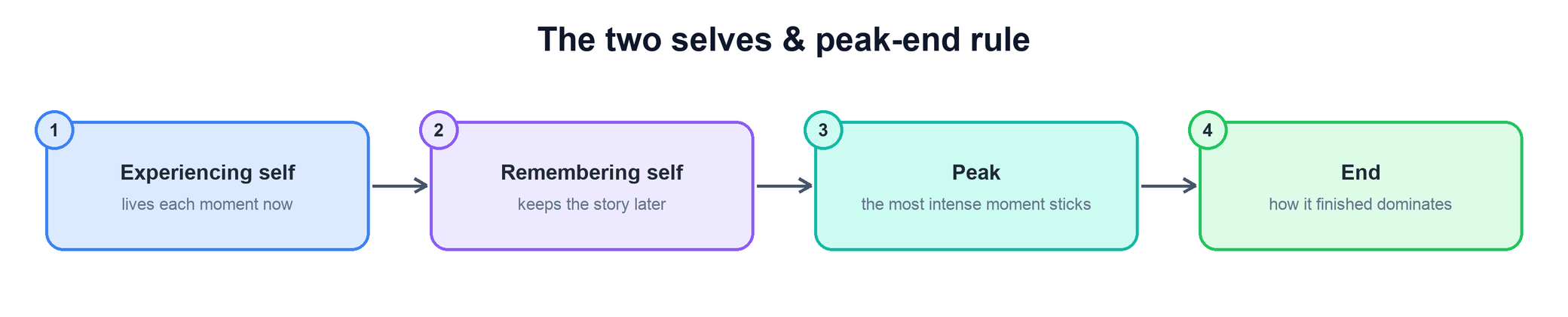
The final turn of the book is about wellbeing, and it introduces a different pair: the experiencing self and the remembering self. The experiencing self is the one that actually lives each moment — the you that feels the pain or pleasure right now, moment to moment. The remembering self is the one that keeps score afterward, tells the story, and makes decisions about the future. They frequently disagree, and it is the remembering self that wins — we choose based on remembered experience, not lived experience.
The self that lives an experience and the self that remembers it are different judges; memory is written mostly by the peak moment and the ending, not by the average or the duration.
Memory follows two quirks that badly misrepresent the actual experience:
The peak-end rule. We remember an experience by an average of how it felt at its most intense moment (the peak) and how it felt at the end — not by its overall average. A painful procedure that ends mildly is remembered as better than a shorter one that ends at its worst.
Duration neglect. How long an experience lasted has almost no effect on how we remember it. A two-week and a one-week vacation of equal quality leave nearly the same memory, even though the experiencing self lived twice as much of the good one.
The unsettling implication is that we routinely make choices to please the remembering self — optimizing for the story — at the expense of the experiencing self that actually has to live through the time.
7. Applying it at work
The ideas map directly onto engineering leadership, where fast intuition and high-stakes judgment collide constantly:
Fight the planning fallacy. Estimate from the outside view — how long did comparable projects actually take? — and add explicit buffers. Treat a detailed inside-view plan as a best case, not a forecast.
Use checklists and pre-mortems. Both are deliberate ways to slow System 1 down. A pre-mortem (“imagine this launch failed — why?”) licenses dissent and surfaces risks that WYSIATI would otherwise hide.
Watch for anchoring. The first number on the table — a rough estimate, an opening salary figure, a proposed headcount — will drag every later number toward it. Set anchors deliberately and question inherited ones.
Design good “ends.” Because of the peak-end rule, how a retro, a launch, or a tough project ends shapes how the whole thing is remembered. Close deliberately: acknowledge the peak, end on something constructive.
Structure decisions to engage System 2. Write down assumptions, separate facts from stories, get independent estimates before people anchor on each other, and judge past decisions by whether they were sound at the time — not by their outcome (defeating hindsight bias).
Worked example: an alarming incident distorts priority
This fictional situation illustrates a possible application, not a guaranteed result or a claim about your workplace.
Sequence for this example. The table explains the evidence and decision at each step.
Step
Evidence, decision, and expected result
Describe the salient incident
Its vividness may dominate the discussion, but severity and actual frequency both matter.
Compare base rates and consequences
Use defined populations/time windows, impact, uncertainty, and alternative causes.
Separate evidence from a story
A before/after improvement can include regression to the mean or confounding; it does not automatically prove the intervention caused it.
Choose a revisable decision
Record assumptions, constraints, uncertainty, and what evidence would change the priority.
Check your understanding: Is loss aversion always exactly twice gain sensitivity?
No. Prospect theory models context-dependent choices; empirical magnitudes vary. Social-priming claims also need replication/context caveats.
Practice with your own situation
Choose one idea from the book. Describe a real situation, competing explanations, a small appropriate action, how you would observe its result, and what would make you stop or revise it. Do not label or diagnose people from the framework.
Use genuine, safe-to-share evidence. Example numbers here illustrate reasoning; they are not claims about your work or a guaranteed outcome.
The past looks explainable, so we overpredict the future; fix it with the outside view.
Prospect theory
We judge from a reference point and feel losses about twice as much as gains.
The two selves
Memory is written by peak and end, not average or duration — and it drives our choices.
The recurring theme: intuition is powerful and mostly right, which is exactly why its errors are so hard to catch. You rarely fix a bias by trying harder in the moment — you fix it by changing the process, so System 2 is forced to look before System 1’s confident answer gets signed off.