An independent study guide to the author's ideas, their practical use, and their limitations.
Student edition · understand, apply, verify
Understand staff-plus scope, influence, and enabling work without confusing archetypes with universal titles.
What you should be able to do: Explain the main idea in your own words, apply it to a concrete situation, and state what the framework/evidence does not establish.
Original study summary, not a replacement for the book or a universal workplace policy. Distinguish the author's framework, illustrative examples, and empirical evidence. Effects depend on context; preserve dignity, safety, and appropriate privacy.
For a long time the only visible way to grow past senior engineer was to become a manager. This book maps out the other road: the staff-plus track, where you keep building and lead through technical judgment and influence rather than a reporting chain. The core message is that staff engineering is a genuinely different job — not just "senior with more years" — and that both getting the title and doing it well require deliberate, and sometimes uncomfortable, choices. What follows is a summary of the main ideas in my own words, meant as a study aid.
This is an original high-level summary written for personal study. All concepts and terminology are the work of the author; read the book for the interviews, stories, and depth behind each idea.
Read these definitions first, or use the linked terms as you go. The examples and limitations are local to this guide; companion pages are optional.
Staff-plus archetypes and scope
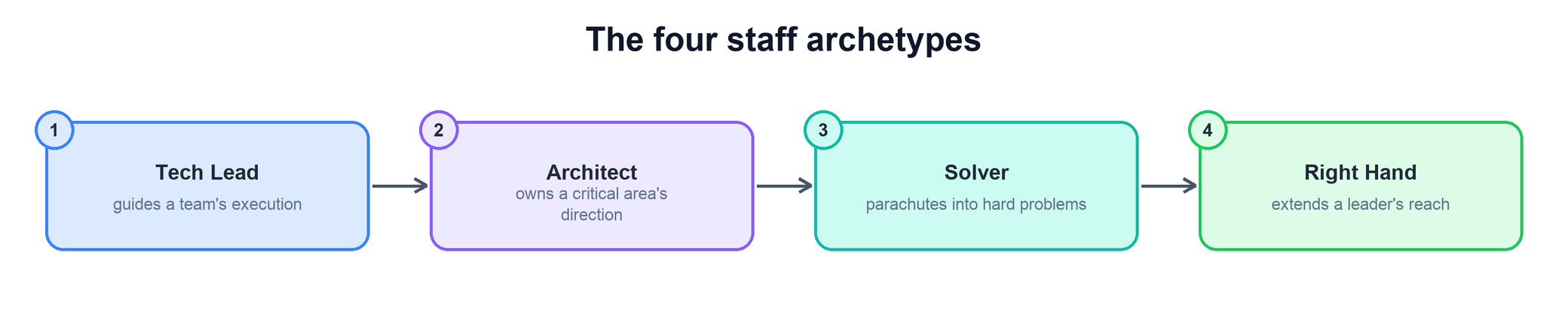
Larson describes Tech Lead, Architect, Solver, and Right Hand as recurring forms of staff-plus work. They organize technical influence beyond one individual task.
Example. A cross-team reliability initiative needs someone to coordinate interfaces and decisions, not necessarily author every code change.
Boundary. Archetypes are not fixed titles or universal promotion criteria. Match real organizational needs, scope, decision rights, and fair credit for enabling work.
Ownership, accountability, and decision rights
Ownership names who drives follow-through; accountability names who answers for outcomes. Decision rights specify who chooses/approves and who is consulted.
Example. A migration has a coordinating owner, service owners, and named release authority.
Boundary. DRI/RACI/DACI are local conventions, not guarantees. Role labels do not replace authority, capacity, and follow-through.
Stakeholders and alignment
A stakeholder is affected by or able to affect a decision. Alignment means understanding goals, constraints, tradeoffs, and the decision process; it does not require unanimous agreement.
Example. Finance values cost predictability, customers migration effort, and operations safe recovery. State these criteria before choosing.
Boundary. Consultation is not an unlimited veto. Name decision authority, required evidence, deadline, and escalation.
Decision records and reversible experiments
Record the problem, options, evidence, constraints, owner, chosen tradeoff, and reconsideration trigger. A reversible test reduces uncertainty before large commitment.
Example. Try one tenant with success/abort metrics and a data-safe rollback plan.
Boundary. Timeboxing does not bypass compliance/safety. Reversible means effects and data can actually recover, not merely that a flag exists.
Outputs, outcomes, and measurement
Outputs are produced things; outcomes are changes for users/business/team. Useful metrics state definition, denominator, population, period, and attribution limits.
Example. 'Shipped a tool' is output. 'Median onboarding fell ten to six days in this cohort' is an outcome with sample/context caveats.
Boundary. Before/after does not prove sole causation. Avoid gaming, selection bias, hidden costs, and unlike-team comparisons.
1. Beyond senior — the staff-plus role
Senior engineer is, for most companies, the "terminal" level — the point at which you are trusted to own a meaningful chunk of work end to end and no one expects you to keep climbing. Staff and above is a different game entirely. The change is not that you write more code or know more frameworks; it is that your scope stops being a single team. Your job becomes the technical health of a system, a domain, or an organization that is bigger than any one team can hold.
Two shifts define the role. First, you lead without direct authority: you rarely manage the people whose work you are steering, so you cannot simply assign tasks — you have to earn the right to be listened to. Second, your impact flows through influence rather than personal output. A senior engineer is measured largely by what they ship; a staff engineer is measured by whether the decisions, standards, and directions they set make everyone around them more effective. Paradoxically, that often means writing less of the code yourself while being responsible for more of the outcome.
2. The four archetypes
One of the book's most useful ideas is that "staff engineer" is not a single shape. Larson identifies four recurring archetypes. Most people lean toward one, and knowing which one fits you — and which one your organization actually needs — is central to both getting the title and succeeding after it.
Archetype
What they do
When an org needs it
Tech Lead
Guides the execution of a single team — shaping the roadmap, the architecture, and how the work gets done day to day, usually alongside an engineering manager.
When a team is large or complex enough that someone needs to own the "how" of the technical work full time.
Architect
Owns the direction, quality, and long-term coherence of a critical area or system that spans several teams.
When a domain is central, complex, and long-lived enough that fragmented per-team decisions would cause real harm.
Solver
Parachutes into the thorniest, most ambiguous problems and drives them to resolution, then moves on to the next fire.
When leadership needs a trusted person to attack whatever the current highest-risk problem happens to be.
Right Hand
Extends the reach of a senior leader — carrying their context, running initiatives on their behalf, and acting with their authority.
When an organization is large enough that a single leader can no longer be present for every important decision.
The four common shapes of a staff-plus role. Most engineers lean toward one; the right fit depends as much on the organization's needs as on your own strengths.
These are not rigid job titles — people move between them over a career, and a single role may blend two. But naming them helps you talk concretely about what kind of staff engineer you want to be and whether that kind of work even exists where you are.
3. What staff engineers actually do
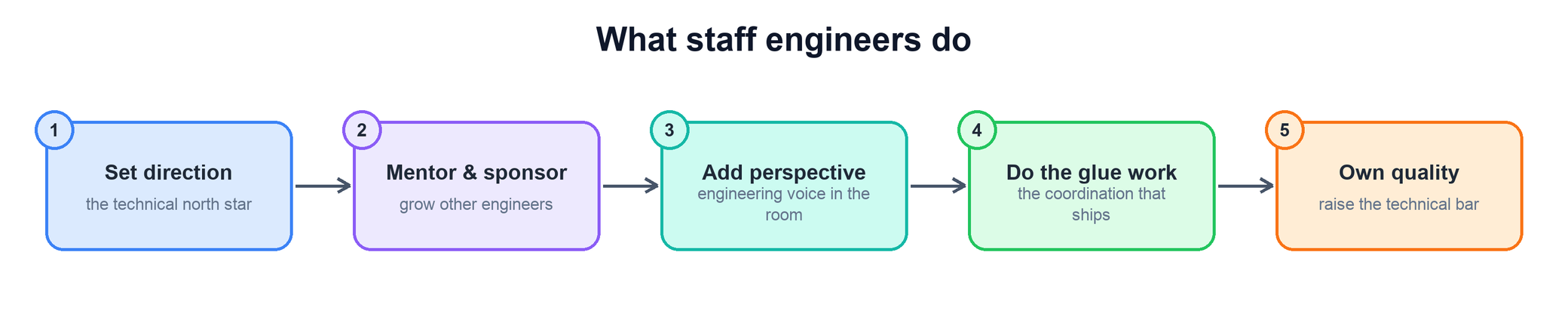
Regardless of archetype, the day-to-day work of a staff engineer clusters around a handful of high-leverage activities. Very little of it looks like the heads-down coding that got you here.
The recurring activities of staff-plus work — most of it is leverage through other people and decisions rather than personal output.
Set technical direction. Decide, or heavily shape, where the technology is going — the architecture, the standards, the big bets — so that many teams pull in the same direction.
Mentor and sponsor. Mentoring gives advice; sponsorship spends your own credibility to put others into opportunities. Sponsorship is the higher-leverage of the two and a defining part of the role.
Provide engineering perspective in the room. Be the person who makes sure technical reality is represented when priorities, tradeoffs, and commitments are being decided.
Do the "glue work." The unglamorous coordination — unblocking teams, aligning interfaces, chasing down the thing no one owns — that quietly determines whether large efforts succeed.
Own quality and be a bridge. Hold the bar on technical quality, and translate between engineering and leadership so each understands what the other actually needs.
4. Being glue & the "not-promotable" trap
Much of what makes a staff engineer valuable is glue work: the invisible coordination that holds a project together — noticing what is falling through the cracks, aligning teams that are drifting apart, writing the doc that unblocks three groups, keeping an effort on track when no single person owns it. This work is often what separates a project that ships from one that stalls.
The trap is that glue work is easy to miss and easy to undervalue. Because it does not produce a shiny artifact with your name on it, it can quietly consume your time while your promotion case looks thin — the "not-promotable" pattern where the very work that keeps everyone else productive fails to register as your impact. The lesson is not to stop doing it, but to make it visible: describe it as the leadership it is, connect it explicitly to the outcomes it enabled, and make sure the people who evaluate you understand that the effort would have failed without it.
5. Getting the title
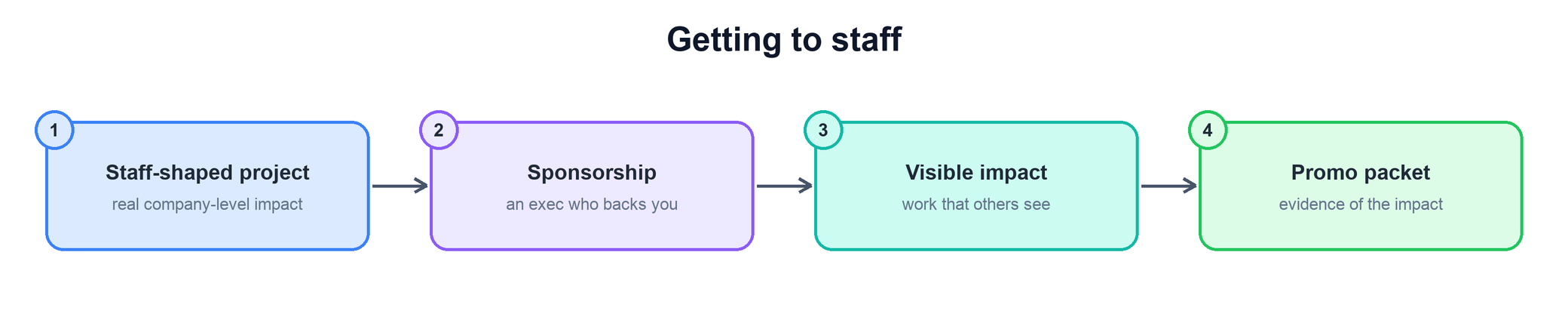
Getting promoted to staff is a fundamentally different game from getting promoted to senior. Senior promotion is largely about consistently doing excellent individual work; you can more or less earn it on your own. Staff promotion depends on company-level impact and other people's judgment, so it is often not fully within your control.
The path to the title: real staff-shaped work, an executive who sponsors you, impact others can see, and a packet that documents it.
Find a real staff-shaped project. You cannot demonstrate staff-level impact without staff-level work — a problem whose blast radius is bigger than one team. If that work does not exist where you are, that itself is a signal.
Earn executive sponsorship. You need a senior leader who believes in you and will actively argue your case in the rooms you are not in. Without a sponsor, even strong work often stalls.
Build a promotion packet with evidence. Assemble concrete proof of company-level impact — not "I worked hard" but "this decision or effort changed these outcomes for these teams."
Accept that it is partly out of your hands. Timing, headcount, org needs, and politics all play a role. Do the work and make the case, but do not treat the title as a pure meritocracy or tie your self-worth to its timing.
6. Operating at staff
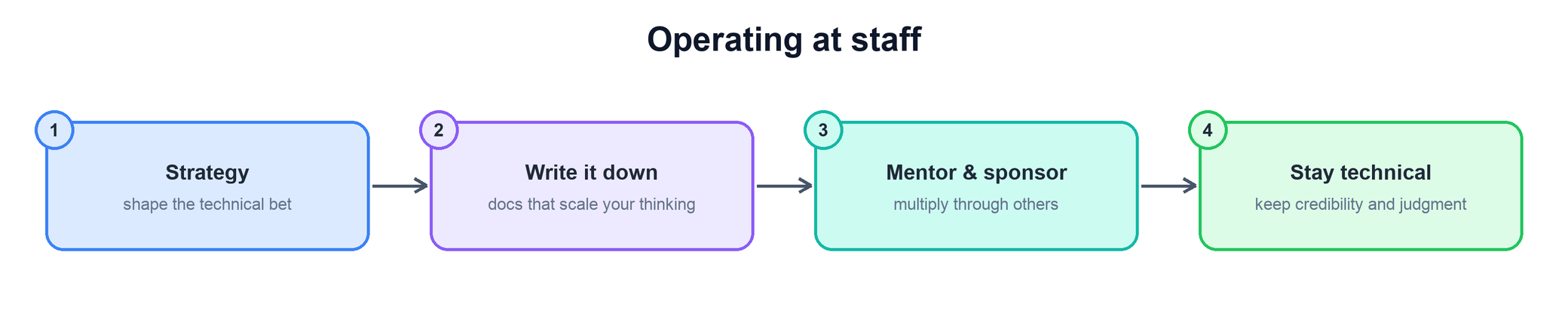
Landing the title is the start, not the finish. Operating well at staff calls for a set of habits that are different from what made you a strong senior engineer.
Habits that make staff-plus work sustainable and effective — strategy, writing, growing others, and staying close to the technology.
Engineering strategy. Learn to reason about the long game — where the technology should head and why — and to write it down so others can build on it. Good strategy usually grows out of a series of hard decisions, not a grand up-front plan.
Writing that scales your thinking. Design docs, RFCs, and clear written arguments let your judgment reach far more people than any meeting can. Writing is one of the highest-leverage staff skills.
Manage your energy. The role is broad and open-ended; without deliberate focus it will sprawl. Protect energy for the work that only you can do.
Stay technical. Your influence rests on technical credibility and judgment. Drift too far from the actual systems and you lose both.
Say no. Because you can help with almost anything, you have to choose. Declining lower-leverage work is what makes room for the high-leverage work.
7. Applying it — planning your path
If you are aiming for staff, the book's advice turns into a short, concrete checklist:
Pick an archetype that fits you. Decide whether you want to be a tech lead, architect, solver, or right hand — and check that your organization actually needs that shape.
Find sponsorship. Build a relationship with a senior leader who will back you and advocate for you when you are not in the room.
Do visible, high-leverage work. Seek out the staff-shaped project, and make sure your impact — including the glue work — is legible to the people who evaluate you.
Write things down. Use design docs, RFCs, and strategy writing both to increase your leverage and to leave evidence of company-level impact.
Worked example: coordinate a shared reliability contract
This fictional situation illustrates a possible application, not a guaranteed result or a claim about your workplace.
Sequence for this example. The table explains the evidence and decision at each step.
Step
Evidence, decision, and expected result
Find the cross-team problem
Services disagree on freshness and recovery expectations; local fixes do not resolve the interface.
Create shared technical context
Record contracts, alternatives, dependency risks, evidence, and decision rights.
Enable other owners
Lead review/prototyping and help teams own their parts; do not centralize every implementation.
Show real impact
Track agreed quality/customer outcomes and give accurate shared credit, including less-visible enabling work.
Check your understanding: Must every staff engineer fit exactly one archetype?
No. Roles blend and depend on organization needs, scope, and decision authority.
Practice with your own situation
Choose one idea from the book. Describe a real situation, competing explanations, a small appropriate action, how you would observe its result, and what would make you stop or revise it. Do not label or diagnose people from the framework.
Use genuine, safe-to-share evidence. Example numbers here illustrate reasoning; they are not claims about your work or a guaranteed outcome.
Staff engineering is a real, distinct kind of leadership — broad in scope, exercised through influence, and earned as much through visibility and sponsorship as through raw skill.
Idea
The one-line takeaway
The role
Scope beyond one team; lead through influence, not authority.
Archetypes
Tech Lead, Architect, Solver, Right Hand — know which fits you and your org.
The work
Set direction, mentor and sponsor, own quality, and do the glue work.
Glue work
Invisible coordination is real leadership — make it visible.
Getting the title
Staff-shaped project + sponsorship + evidence — and it is partly out of your control.
Operating
Strategy, writing, staying technical, and saying no.
The recurring theme: growing past senior does not require becoming a manager, but it does require changing what you optimize for — from personal output to the leverage your judgment, direction, and sponsorship give everyone around you.