Leaders Eat Last — Concepts and Practical Examples
An independent study guide to the author's ideas, their practical use, and their limitations.
Student edition · understand, apply, verify
Apply service-oriented leadership while distinguishing a practical principle from simplified biological explanations.
What you should be able to do: Explain the main idea in your own words, apply it to a concrete situation, and state what the framework/evidence does not establish.
Original study summary, not a replacement for the book or a universal workplace policy. Distinguish the author's framework, illustrative examples, and empirical evidence. Effects depend on context; preserve dignity, safety, and appropriate privacy.
The book starts from a simple observation about the best teams: their people are not braver, smarter, or better paid than anyone else — they simply feel safe among their own. When a leader takes real responsibility for the people in their care, those people stop spending energy protecting themselves from each other and start pointing all of it outward, at the actual challenges the organization faces. What follows is a summary of the core ideas in my own words, meant as a study aid — the book itself carries the stories, biology, and history that make the argument land.
This is an original high-level summary written for personal study. All concepts and terminology are the work of the author; read the book for the stories, research, and depth behind each idea.
Read these definitions first, or use the linked terms as you go. The examples and limitations are local to this guide; companion pages are optional.
Circle of Safety as a leadership principle
Sinek's Circle of Safety asks leaders to reduce unnecessary internal fear and support cooperation, so people can address shared external challenges.
Example. A clear nonretaliation/reporting process and fair incident review make it easier to raise an early risk.
Boundary. Do not infer employee behavior from a simple 'selfish/selfless chemical' model. Neurobiology is complex, and belonging does not eliminate all conflict or threats.
Psychological safety and constructive conflict
A shared belief that asking questions, reporting mistakes, or disagreeing can happen without humiliation or retaliation. It supports learning alongside clear standards.
Example. A junior engineer reports a suspected fault early; the lead examines evidence instead of attacking the person.
Boundary. It does not mean universal comfort/agreement or no accountability. Power, incentives, and context shape who can speak safely.
Coaching, delegation, and expectations
Coaching develops reasoning through questions, practice, and feedback. Delegation transfers defined work/decision responsibility with support. Expectations make outcomes and behaviors explicit.
Example. Delegate a design decision with authority, constraints, check-in, and escalation trigger—not hidden standards.
Boundary. Match support to experience/risk. Performance policies and legal requirements vary; no universal PIP timeline or personality label is a fair diagnosis.
Outputs, outcomes, and measurement
Outputs are produced things; outcomes are changes for users/business/team. Useful metrics state definition, denominator, population, period, and attribution limits.
Example. 'Shipped a tool' is output. 'Median onboarding fell ten to six days in this cohort' is an outcome with sample/context caveats.
Boundary. Before/after does not prove sole causation. Avoid gaming, selection bias, hidden costs, and unlike-team comparisons.
Frameworks versus empirical evidence
A framework organizes thinking; it is not automatically a validated causal law. Evidence needs study design, uncertainty, effect size, population, and replication context.
Example. Growth-mindset practices can help in some settings without making effort alone determine outcomes. Examine structural barriers and actual results.
Boundary. Popular books simplify behavioral/neuroscience findings. Priming or a named model is not a guaranteed workplace intervention.
1. The Circle of Safety
Sinek's Circle of Safety is a leadership principle about reducing unnecessary internal fear and supporting cooperation. Trust can make reporting and collaboration easier, but does not make all threats/conflicts disappear.
Use clear standards, safe reporting, adequate resources, fair accountability, and follow-through. Respect professional boundaries: leadership service is not a demand for unlimited personal sacrifice, loyalty, or availability.
2. The chemicals that drive us
The book uses endorphins, dopamine, serotonin, oxytocin, and cortisol to explain a leadership story. Real neurobiology is multifunctional and context-dependent; these are not a complete set of behavior controls or simple selfish/selfless categories.
Do not diagnose motivation, trust, health, or a 'culture chemical balance' from a person's behavior. Social effects, stress, incentives, resources, and power interact, and popular explanations are not a substitute for empirical or clinical evidence.
Evaluate leadership recommendations through observable support, fair treatment, reporting safety, sustainable workload, and user/team outcomes rather than assuming a particular hormone explains the result.
3. Why the Circle of Safety works
Supportive, predictable, fair leadership can help people share information and collaborate. Whether a particular intervention works depends on context and evidence. It does not justify claims that 'oxytocin flows', 'cortisol dominates', or fear and trust cannot coexist in every situation.
Ask what actual policies, workload, incentives, power differences, and behavior create or reduce risk. Protect appropriate reporting and measure results without medicalizing employee responses.
4. Empathy and abstraction
The great enemy of the Circle of Safety is abstraction. Human empathy is built for people we can see. As organizations grow, leaders increasingly manage through spreadsheets, dashboards, and headcount numbers — and it is frighteningly easy to make a decision that harms thousands of real people when they appear only as a row in a report. Distance and scale quietly erode empathy: the further a leader sits from the humans affected by a decision, the easier it becomes to treat them as numbers to be optimized rather than people to be protected.
The antidote is to keep people connected to the humans they serve and work alongside — to put a face, a name, or a story back where the spreadsheet flattened it. Leaders who walk the floor, who know their people, and who keep the customer’s humanity in view make more humane and, ultimately, better decisions. Managing by metrics alone is managing an abstraction, not a company.
5. Destructive abundance & dopamine cultures
Sinek warns about what he calls destructive abundance: what happens when an organization grows successful enough that the pursuit of results outpaces the culture that produced them. These cultures become short-term and numbers-driven, addicted to the dopamine hit of hitting the next quarterly target. The clearest symptom is a company that lays off loyal people to protect a stock price or a forecast — treating the very people who built the success as an expense to be trimmed.
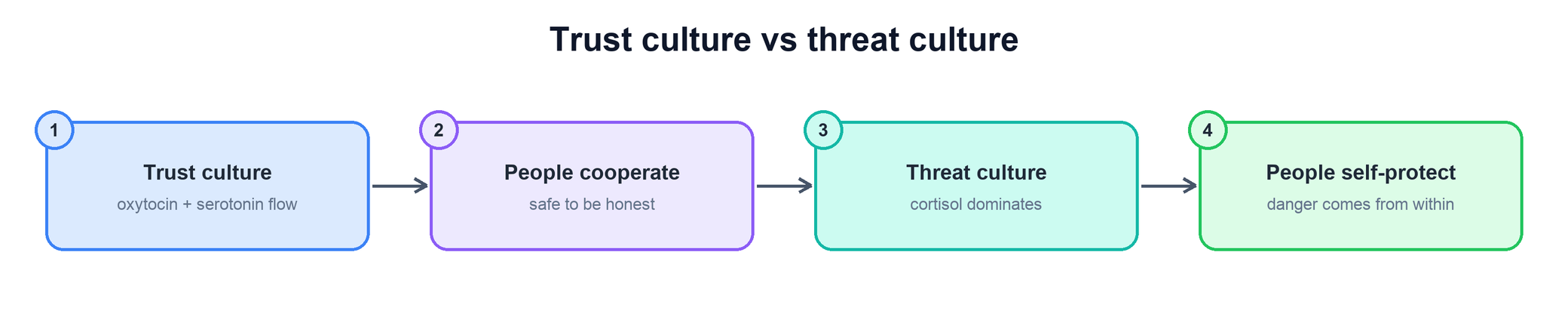
Two cultures, two chemistries. Trust cultures run on oxytocin and serotonin and cooperate; threat cultures run on cortisol and drive people to protect themselves.
The deeper danger is addiction. Dopamine is the same chemical behind our pull toward gambling, alcohol, and our devices — and a culture engineered to reward only the next number, the next metric, the next notification, can hook its people the same way. It feels like performance, but it is chasing a chemical, and it comes at the cost of the slow, trust-building work that actually holds a team together. Every one of these choices is a small withdrawal from the Circle of Safety.
6. Integrity and leading by example
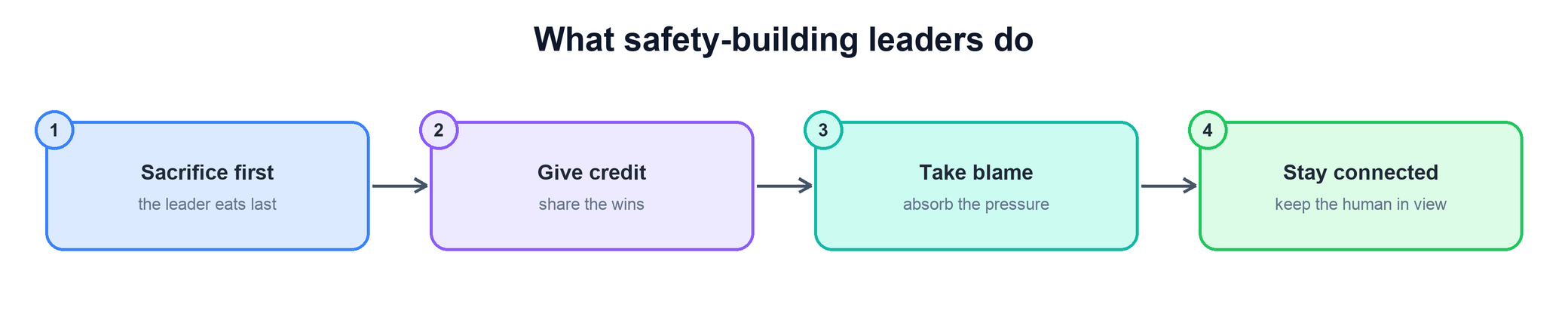
Trust is not won with words; it is earned through sacrifice. Leaders who are willing to give something up — their time, their comfort, their bonus, credit, even their own advancement — for the good of their people prove the contract is real, and their people repay them with trust and discretionary effort you cannot buy. This is the practical meaning of the title: the leader eats last. They give the credit away when things go well and absorb the blame when things go wrong. They go without so their people don’t have to.
Integrity is the day-to-day expression of this: saying what you mean, doing what you say, and behaving the same whether or not anyone is watching. People forgive honest mistakes; what breaks the Circle of Safety is the sense that a leader will protect themselves at the group’s expense. Leading by example is not a slogan — it is the mechanism by which safety spreads through an organization one act at a time.
The everyday behaviors that build a Circle of Safety: put your people first, share the wins, own the losses, and stay connected to the humans involved.
7. Applying it at work
The ideas map directly onto engineering leadership, where the “threats outside” are real deadlines, incidents, and shifting priorities. A few concrete applications:
Protect the team from thrash — act as a shock absorber for shifting priorities and executive churn so your engineers can stay pointed at the actual work instead of the politics around it.
Be the DRI who absorbs pressure — when leadership is anxious about a deliverable, take that heat yourself rather than passing the cortisol straight down to the team.
Build a healthy on-call and incident culture — a Circle of Safety is what lets a tired responder ask for help at 3am; page fairly, back each other up, and never punish someone for escalating.
Give credit generously — name the people who did the work in reviews and to skip-levels; the leader who eats last does not take the plate first.
Run blameless postmortems — make it safe to say “here is what I did and here is what I missed,” so the team fixes the system instead of hiding the truth to protect themselves.
Worked example: an incident report triggers blame
This fictional situation illustrates a possible application, not a guaranteed result or a claim about your workplace.
Sequence for this example. The table explains the evidence and decision at each step.
Step
Evidence, decision, and expected result
Observe the response
People hesitate to report a risk after prior public humiliation.
Change the reporting environment
Set appropriate nonretaliation, clear response roles, and a fair learning/accountability process.
Provide practical support
Staff recovery, clarify expectations, and remove repeat causes instead of asking for heroic loyalty.
Measure the effect
Track reporting timeliness, incident outcomes, and workload. Do not infer neurotransmitter levels from workplace behavior.
Check your understanding: Are dopamine/serotonin/oxytocin simple selfish-versus-selfless switches?
No. Those are the book's simplified explanatory categories, not a reliable neuroscience model for diagnosing teams.
Practice with your own situation
Choose one idea from the book. Describe a real situation, competing explanations, a small appropriate action, how you would observe its result, and what would make you stop or revise it. Do not label or diagnose people from the framework.
Use genuine, safe-to-share evidence. Example numbers here illustrate reasoning; they are not claims about your work or a guaranteed outcome.
The book reduces to a single chain of cause and effect: a leader who sacrifices for their people builds trust, trust creates a Circle of Safety, safety shifts the group from cortisol to oxytocin and serotonin, and a group in that state aims all of its energy at real challenges and pulls together.
Idea
The one-line takeaway
Circle of Safety
Make people feel safe inside so they can fight the threats outside.
The chemicals
Balance selfish drive (endorphins, dopamine) with social trust (serotonin, oxytocin) — and keep cortisol in check.
Why it works
Safety releases trust; threat from within releases fear, and fear kills cooperation.
Empathy & abstraction
Distance and spreadsheets erode empathy; keep people connected to real humans.
Destructive abundance
Beware dopamine-chasing, numbers-first cultures that trade people for quarterly targets.
Integrity
Trust is earned through sacrifice; give credit, take blame, lead by example.
At work
Absorb pressure, protect the team, and make it safe to tell the truth.
The recurring theme: leadership is a choice to put the safety and well-being of your people ahead of your own. Do that, and people give you their best; withhold it, and no incentive plan will make up the difference.