The Five Dysfunctions of a Team — Concepts and Practical Examples
An independent study guide to the author's ideas, their practical use, and their limitations.
Student edition · understand, apply, verify
Use a team's trust, debate, commitment, accountability, and results as discussion prompts rather than a diagnosis.
What you should be able to do: Explain the main idea in your own words, apply it to a concrete situation, and state what the framework/evidence does not establish.
Original study summary, not a replacement for the book or a universal workplace policy. Distinguish the author's framework, illustrative examples, and empirical evidence. Effects depend on context; preserve dignity, safety, and appropriate privacy.
Most teams do not fall apart because the people are incompetent or the strategy is wrong. They fall apart because a handful of very human behaviors — guarding your image, avoiding an awkward argument, staying quiet when a peer drops the ball — compound into a group that cannot pull in the same direction. Lencioni tells the story through a fable about a struggling executive team, but the model underneath is what matters: five dysfunctions that stack on top of one another, each one made possible by the one below it. What follows is a summary of that model in my own words, meant as a study aid — the full book is worth reading for the story and the exercises behind each idea.
This is an original high-level summary written for personal study. All concepts and terminology are the work of the author; read the book for the fable, the model, and the team exercises behind each idea.
Read these definitions first, or use the linked terms as you go. The examples and limitations are local to this guide; companion pages are optional.
Five dysfunctions as a team framework
Lencioni's model names absence of trust, fear of conflict, lack of commitment, avoidance of accountability, and inattention to results as related team patterns.
Example. A team avoids raising a risk, so a decision gets apparent agreement without real understanding. Ask about safety, decision rights, and what evidence was available.
Boundary. The pyramid is an author's organizing model, not a proved universal causal chain. Address immediate harm/quality/accountability while improving trust.
Psychological safety and constructive conflict
A shared belief that asking questions, reporting mistakes, or disagreeing can happen without humiliation or retaliation. It supports learning alongside clear standards.
Example. A junior engineer reports a suspected fault early; the lead examines evidence instead of attacking the person.
Boundary. It does not mean universal comfort/agreement or no accountability. Power, incentives, and context shape who can speak safely.
Ownership, accountability, and decision rights
Ownership names who drives follow-through; accountability names who answers for outcomes. Decision rights specify who chooses/approves and who is consulted.
Example. A migration has a coordinating owner, service owners, and named release authority.
Boundary. DRI/RACI/DACI are local conventions, not guarantees. Role labels do not replace authority, capacity, and follow-through.
Outputs, outcomes, and measurement
Outputs are produced things; outcomes are changes for users/business/team. Useful metrics state definition, denominator, population, period, and attribution limits.
Example. 'Shipped a tool' is output. 'Median onboarding fell ten to six days in this cohort' is an outcome with sample/context caveats.
Boundary. Before/after does not prove sole causation. Avoid gaming, selection bias, hidden costs, and unlike-team comparisons.
Frameworks versus empirical evidence
A framework organizes thinking; it is not automatically a validated causal law. Evidence needs study design, uncertainty, effect size, population, and replication context.
Example. Growth-mindset practices can help in some settings without making effort alone determine outcomes. Examine structural barriers and actual results.
Boundary. Popular books simplify behavioral/neuroscience findings. Priming or a named model is not a guaranteed workplace intervention.
1. The model
Lencioni organizes five related patterns: low trust, avoided conflict, weak commitment, avoided accountability, and neglected shared results. The pyramid suggests examining foundations when repeated problems appear.
It is not a proof that every team follows a single causal chain or that only bottom-up action is valid. A missed commitment can arise from unclear scope, missing resources, dependencies, incentives, or an unsafe environment. Explore evidence before assigning a dysfunction label.
Build safe constructive disagreement and clear decision rights while enforcing appropriate quality/conduct standards. Accountability and trust can be improved together; do not defer action on harmful behavior until an abstract trust program finishes.
2. Dysfunction 1 — Absence of Trust
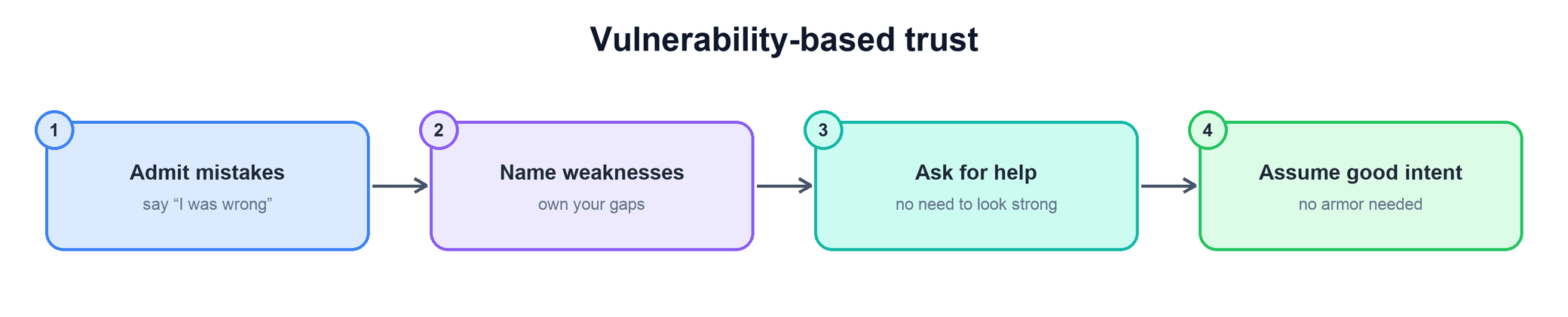
Trust is the base of the pyramid, but the book means a very specific kind of trust: vulnerability-based trust. This is not the ordinary, predictive trust of “I can rely on you to do what you said.” It is the willingness to be genuinely exposed in front of the team — to admit a mistake, name a weakness, ask for help, or say “I don’t know” without fear it will be used against you. On a trusting team, no one wastes energy managing their image.
Vulnerability-based trust is a set of everyday behaviors, not a feeling — the willingness to be exposed without armor.
Symptom: people conceal weaknesses and mistakes, hesitate to ask for help, dread meetings, and hold back honest opinions to avoid looking bad. Everyone is polite and nothing is real.
Fix: the leader has to go first — modeling vulnerability by openly owning their own mistakes and limitations sets the permission for everyone else. Structured exercises help too: personal-history sharing, honest strengths-and-weaknesses discussions, and consistent follow-through so people learn that being open is safe rather than costly.
3. Dysfunction 2 — Fear of Conflict
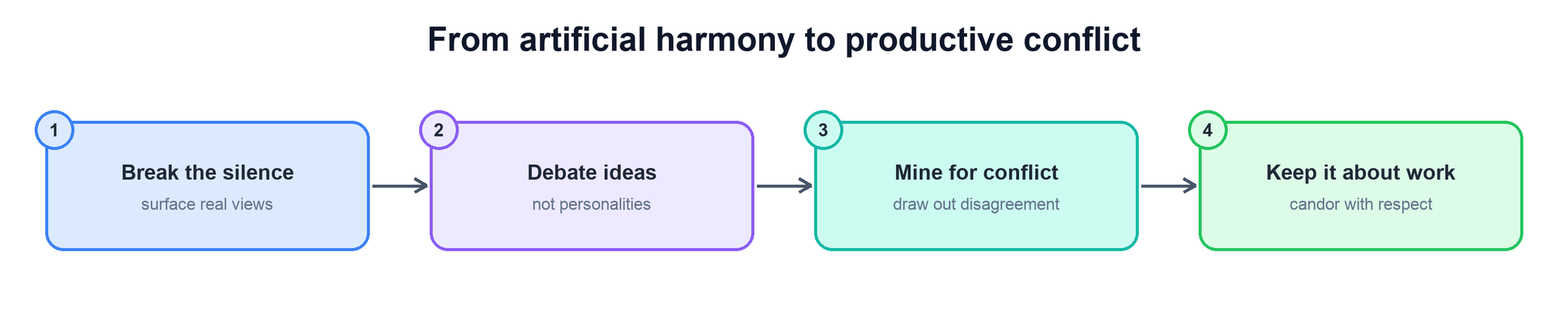
Teams that lack trust are incapable of unfiltered, passionate debate about ideas. Instead they settle for artificial harmony — a surface calm where everyone nods in the meeting and then relitigates the decision in the hallway afterward. The crucial distinction is between productive ideological conflict (a hard argument about the best answer) and destructive interpersonal conflict (attacks on people). Healthy conflict is about ideas and stays respectful; it is the fastest way to a good decision and it is a sign of a strong team, not a broken one.
Moving from polite silence to real debate — conflict about ideas, never about people.
Symptom: boring, guarded meetings; important topics avoided; back-channel politics and personal attacks replacing open debate; decisions made without the friction that would have improved them.
Fix: legitimize conflict by naming it as a good thing and expecting it. Someone can act as a “miner of conflict” who deliberately draws out buried disagreements, and real-time permission (“this is exactly the debate we need”) reassures people that the discomfort is healthy and worth pushing through.
4. Dysfunction 3 — Lack of Commitment
Without honest debate, people do not genuinely buy in — they may nod along, but they never truly commit. Commitment does not require consensus or certainty; it requires two things: clarity (everyone knows exactly what was decided) and buy-in (everyone was heard, so they can support the decision even if it wasn’t their first choice). This is the essence of “disagree and commit”: once your view has been genuinely aired and weighed, you get behind the decision fully, even if you argued against it.
Symptom: ambiguity about direction and priorities; endless second-guessing and revisiting of decisions; missed windows because the team waited for perfect certainty; a “fear of failure” that masquerades as caution.
Fix: close every discussion by explicitly restating the decision, who owns it, and the deadlines — then confirm everyone can commit. Cascade the message so the whole org hears the same thing. Deliberately favor clarity and closure over waiting for consensus or guarantees.
5. Dysfunction 4 — Avoidance of Accountability
When there was no real commitment, people have no firm standard to hold each other to — and so they don’t. The key insight here is that the most effective accountability is peer-to-peer, not just top-down from the manager. On a healthy team, peers call each other out on behaviors and results that hurt the group, precisely because they respect each other and share a clear standard. Waiting for the boss to be the sole enforcer is slow and breeds resentment.
Symptom: mediocrity tolerated; missed deadlines and low standards go unaddressed; resentment builds among the people who do meet the bar; the leader becomes the lone source of discipline.
Fix: make goals and standards public so everyone can see who owes what. Use regular, lightweight progress reviews and team rewards tied to collective outcomes so peers naturally lean on each other. The leader’s job is to be the backstop, not the first line — encouraging the team to police itself.
6. Dysfunction 5 — Inattention to Results
At the top of the pyramid is the ultimate failure: people putting something ahead of the collective results of the team. That something is usually individual ego and status (personal career, recognition) or the survival of their own sub-team (protecting their department’s budget, headcount, or turf) rather than the shared scoreboard. When every layer below has failed, there is nothing left to keep people focused on the one thing that actually matters — whether the team as a whole wins.
Symptom: the team stagnates and loses to competitors; results-oriented people leave; individuals chase personal or departmental wins; success is measured by titles and turf, not team outcomes.
Fix: keep the collective results visible and public — a small set of shared, outcome-based goals that the whole team is measured against. Tie rewards and recognition to team results rather than individual heroics, so that the group’s success is unambiguously everyone’s success.
7. Putting it together
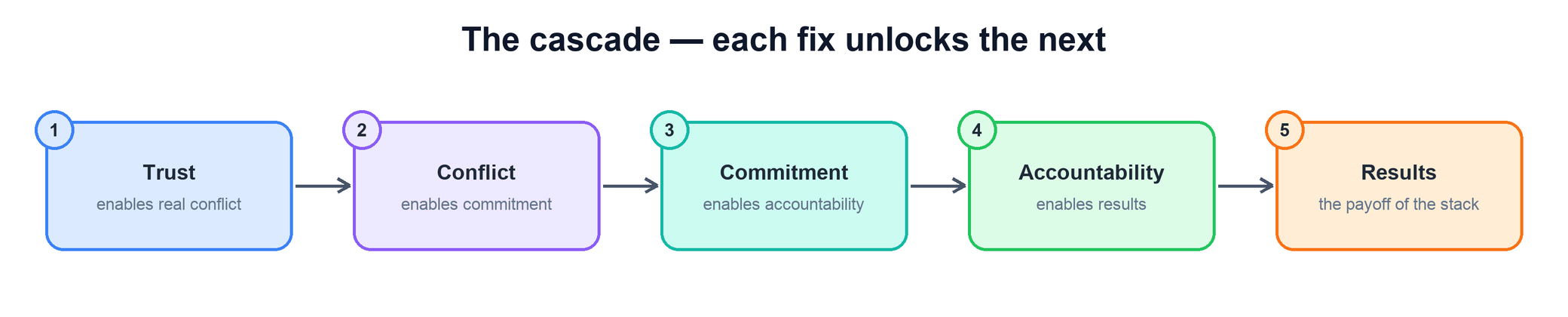
The power of the model is the cascade: each dysfunction is not just a problem in isolation, it actively enables the next one up. No trust makes fear of conflict inevitable; unaddressed conflict guarantees weak commitment; weak commitment removes the standard needed for accountability; and without accountability, attention to collective results collapses. Fix a lower layer and you unlock the one above it — which is why the model is always worked bottom-up.
The cascade in the healthy direction — each fix unlocks the next layer up the pyramid.
Dysfunction
What it looks like
The fix / behavior
Absence of Trust
People hide mistakes and weaknesses; everyone manages their image; no one asks for help.
Artificial harmony in meetings; real debate happens in the hallway; back-channel politics.
Mine for conflict; legitimize passionate debate about ideas; keep it about work, never people.
Lack of Commitment
Ambiguity, endless revisiting of decisions, waiting for certainty; no real buy-in.
Clarity + buy-in; restate decisions and owners; “disagree and commit.”
Avoidance of Accountability
Low standards tolerated; missed deadlines ignored; only the boss enforces anything.
Peer-to-peer accountability; public goals and standards; regular progress reviews.
Inattention to Results
Ego, status, and sub-team survival beat team outcomes; the team stagnates.
Make collective results public; reward team outcomes over individual heroics.
8. Applying it at work
The model maps cleanly onto the daily rhythms of an engineering team. A few concrete practices:
Trust — use 1:1s and team offsites to build real relationships; leaders openly own their own mistakes and gaps so the team learns that vulnerability is safe.
Conflict — run healthy design and architecture debates where the best argument wins; treat a hard technical disagreement as a good meeting, not a failed one.
Commitment — use disagree-and-commit in planning; close every planning discussion by restating the decision, the owner, and the date, then confirm everyone can get behind it.
Accountability — treat peer code review, design review, and on-call handoffs as peer-to-peer accountability, where teammates hold each other to the bar rather than waiting for the manager.
Results — track team-level metrics (reliability, delivery, customer outcomes) and reward them over individual heroics, so the shared scoreboard is what everyone optimizes for.
Worked example: a decision gets silence instead of commitment
This fictional situation illustrates a possible application, not a guaranteed result or a claim about your workplace.
Sequence for this example. The table explains the evidence and decision at each step.
Step
Evidence, decision, and expected result
Observe the pattern
A design is approved but people later reveal unresolved concerns.
Avoid assuming one cause
Check fear, unclear ownership, missing context, competing priorities, and the decision process.
Improve the process
Invite written dissent, clarify criteria/authority, and record decisions with review triggers.
Address outcomes and harm
Measure follow-through and quality; immediate conduct/safety issues need action even while trust is being developed.
Check your understanding: Does the pyramid prove trust must be fixed before any accountability?
No. It is an author's model, not an empirically universal causal or sequencing law.
Practice with your own situation
Choose one idea from the book. Describe a real situation, competing explanations, a small appropriate action, how you would observe its result, and what would make you stop or revise it. Do not label or diagnose people from the framework.
Use genuine, safe-to-share evidence. Example numbers here illustrate reasoning; they are not claims about your work or a guaranteed outcome.
The whole model reduces to a single chain: build trust, and honest conflict becomes possible; have real conflict, and genuine commitment follows; commit clearly, and peers can hold each other accountable; be accountable, and the team can finally focus on collective results.
Layer
The one-line takeaway
Trust
Be vulnerable — admit mistakes and ask for help; the leader goes first.
Conflict
Debate ideas openly; artificial harmony is a warning sign, not a virtue.
Commitment
Clarity plus buy-in; disagree and commit, don’t wait for certainty.
Accountability
Peers hold peers to the standard, not just the boss.
Results
Put the team’s collective outcome ahead of ego, status, and turf.
The recurring theme: teamwork fails from the bottom up, so it must be rebuilt from the bottom up. Start with the courage to be vulnerable, and every layer above it becomes reachable.